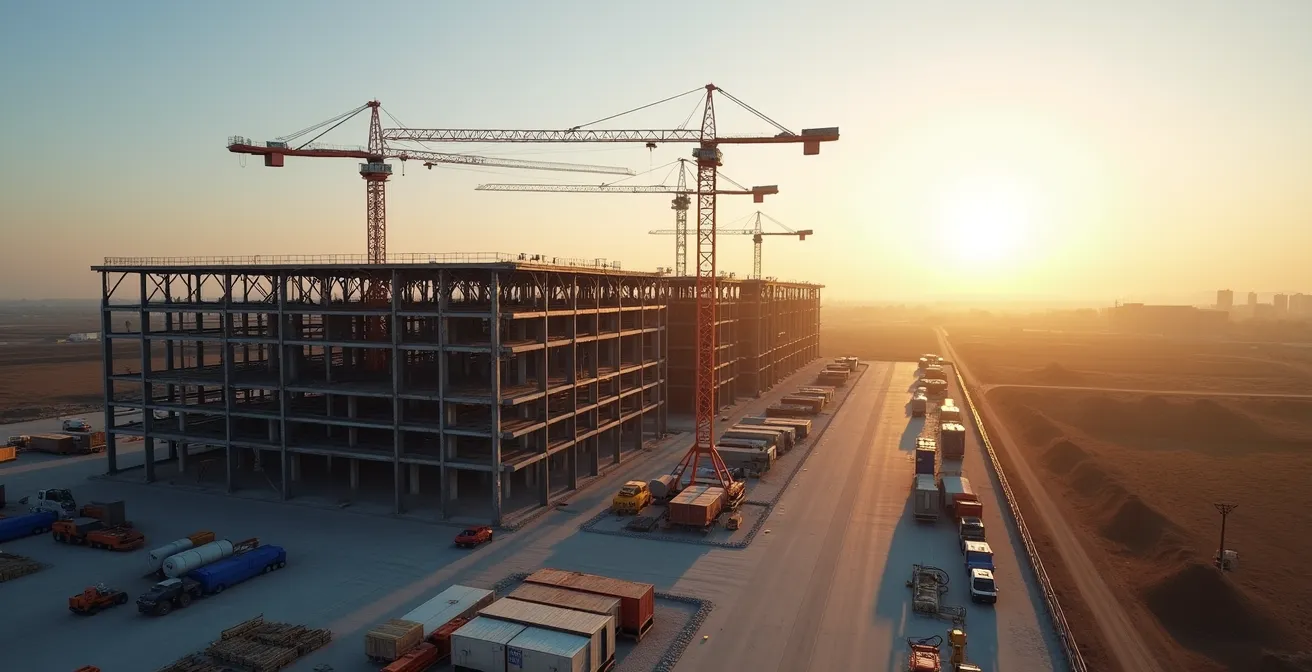
In summary:
- Success in today’s industrial market requires moving beyond basic “big box” construction and engineering a high-performance asset.
- Focus on non-negotiable specifications demanded by automated logistics: minimum 32-foot clear heights, robot-ready floors, and wide column spacing.
- Anticipate future tenant needs by designing for “cubic velocity”—the speed of goods movement—not just storage capacity.
- Mitigate risks by conducting rigorous environmental due diligence and understanding the real drivers of pre-construction budget overruns.
- The most profitable strategy is to build for the next generation of e-commerce and robotics tenants, securing long-term, high-value leases.
For a residential developer, the industrial real estate sector looks like a gold rush. The relentless growth of e-commerce has created seemingly insatiable demand, pushing rents and valuations to record highs. The pivot seems logical: swap out complex residential builds for what appears to be a simpler “big box” formula. However, this assumption is the first and most expensive mistake a new industrial developer can make. The days of succeeding with a generic warehouse are over, especially in supply-constrained markets where land is precious.
Conventional wisdom says to focus on location and financing. While true, this advice is dangerously incomplete. Today’s institutional-grade tenants—the Amazons, FedExes, and third-party logistics (3PL) giants of the world—don’t just lease square footage; they lease operational efficiency. Their decision to sign a long-term lease hinges on a building’s technical specifications and its ability to support sophisticated automation. What defines a Class A industrial building is no longer just its location, but its performance metrics. This is a fundamental shift from the residential mindset, where aesthetics and amenities often drive value.
The true key to dominating this market is not just building a warehouse, but engineering a high-performance asset where every specification is a direct response to the non-negotiable demands of logistics automation and e-commerce velocity. It’s about understanding that an extra four feet of clear height isn’t a feature; it’s a gateway to an entirely different class of tenant. It’s about designing for “asset choreography”—the seamless flow of robots and people—rather than just a static layout.
This guide provides the expert playbook for making that pivot successfully. We will deconstruct the critical specifications that separate a profitable Class A facility from an obsolete one, analyze the hidden risks that can derail a project before groundbreaking, and provide the framework for designing buildings that attract the next generation of high-value logistics tenants.
This article will guide you through the essential strategic decisions required to thrive. Explore the detailed breakdown in the summary below to navigate the key aspects of modern industrial development.
Summary: A Developer’s Playbook for Class A Industrial
- Why 32-Foot Clear Height is the New Minimum for Institutional Tenants?
- How to Assess “Last Mile” Validity for Logistics Sites?
- Speculative Build or Build-to-Suit: Which Carries Less Risk in 2024?
- The Phase 2 Environmental Surprise That Can Bankrupt Your Industrial Project
- How to Design Column Spacing to Accommodate Future Robotics Tenants?
- Why Warehouses Are Outperforming Retail Centers in the E-commerce Era?
- Why 60% of New Developments Go Over Budget Before Breaking Ground?
- How to Design “Robot-Ready” Buildings to Attract Next-Gen Logistics Tenants?
Why 32-Foot Clear Height is the New Minimum for Institutional Tenants?
For a developer accustomed to residential ceiling heights, the obsession with clear height in the industrial world can seem excessive. However, this single metric is arguably the most important factor in defining a modern Class A facility. The standard has shifted decisively from 28 feet to a non-negotiable minimum of 32 feet, with forward-thinking developers already pushing to 36 or even 40 feet. The reason is simple: modern logistics isn’t about square footage; it’s about cubic volume and the speed at which goods move through it, a concept best described as “cubic velocity.”
Institutional tenants utilize sophisticated, high-density racking systems that require at least 32 feet to achieve optimal storage. Anything less is immediately disqualified from consideration. The financial incentive is powerful. Shifting from a 28-foot to a 36-foot clear height can unlock as much as 40% more leasable cubic space. This allows savvy developers to structure leases based on cubic foot capacity, a far more lucrative model than traditional square foot pricing. This additional height also enables the integration of multi-level mezzanines for value-added services like kitting and returns processing, further increasing a facility’s revenue potential.
The cost-benefit analysis is compelling. While increasing clear height from 32 to 36 feet can add $1.25 to $1.50 per square foot to construction costs, the access to a higher tier of tenants and increased rental income provides a rapid and significant return on investment. In today’s market, building below 32 feet is not a cost-saving measure; it’s a decision to build an obsolete asset from day one, effectively shutting yourself out from the most credit-worthy tenants.
How to Assess “Last Mile” Validity for Logistics Sites?
The term “last mile” is often used loosely, but for a logistics operator, it has a precise and unforgiving meaning. A true last-mile facility is not just “close” to a population center; it’s strategically positioned to minimize drive times and maximize delivery density, directly combating the fact that these final miles can account for over 53% of total supply chain costs. For a developer, correctly identifying a valid last-mile site is the difference between securing a premium rent from a top-tier e-commerce player and being stuck with a generic warehouse in a suboptimal location.
Assessing validity requires a granular analysis beyond a simple map overlay. You must evaluate traffic patterns, roadway congestion at peak delivery hours, and the site’s proximity to a diverse demographic with high e-commerce spending habits. The market opportunity is immense; a recent market analysis forecasts the last-mile sector is projected to reach $82.83 billion by 2033, driven by relentless consumer demand for speed. Tenants are willing to pay a significant premium for locations that enable this speed.
This is where modern technology plays a crucial role. Companies using digital route optimization can see efficiency gains of over 22%, and those with AI-enabled routing reduce delivery window misses by 28%. A developer must ask: does this site empower or hinder these technologies? Can it support a fleet of electric delivery vans? Does it have the space for the organized, high-throughput flow of vehicles required for modern delivery operations?
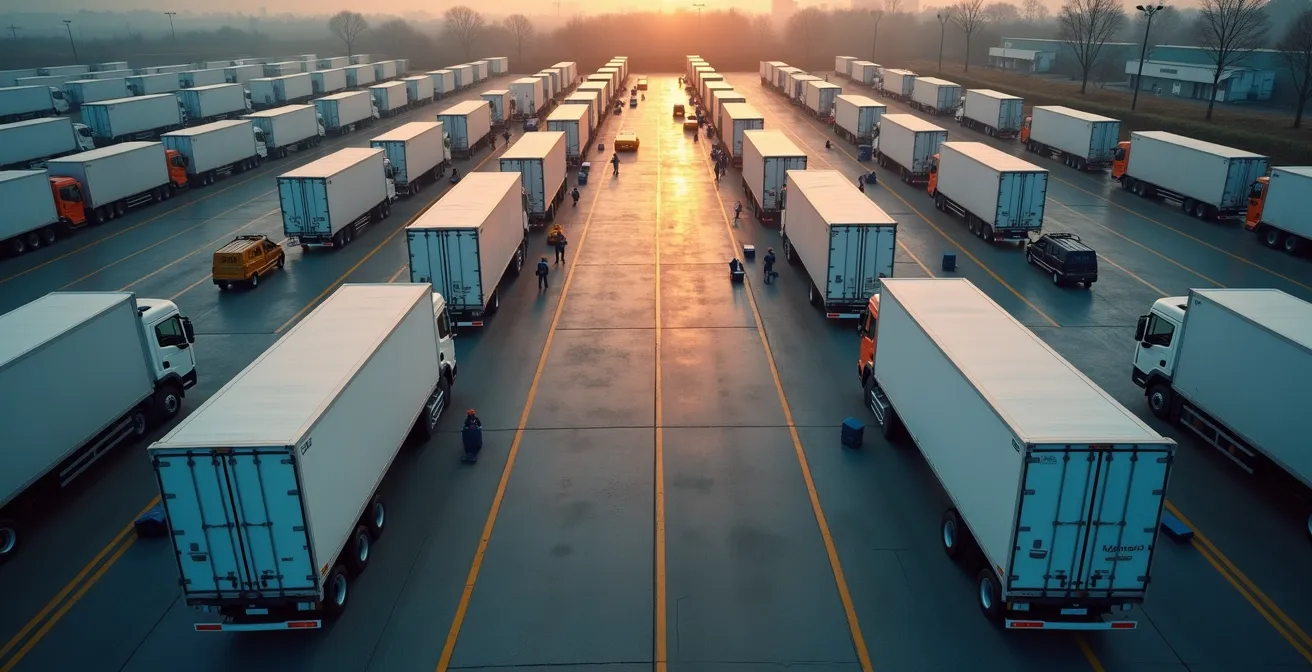
As the image illustrates, a modern last-mile hub is a highly choreographed environment. It’s about more than just loading docks; it’s about designing for the efficient ingress and egress of hundreds of vehicles, providing ample parking and charging infrastructure, and enabling the rapid sorting and loading that defines e-commerce fulfillment. A site that cannot support this level of operational density is not a true last-mile location.
Speculative Build or Build-to-Suit: Which Carries Less Risk in 2024?
The classic developer’s dilemma—build on spec and hope a tenant comes, or wait for a committed tenant before breaking ground—is more complex than ever in the current industrial climate. For a residential developer used to building spec homes, the instinct might be to build a flexible facility and market it broadly. However, the high-stakes world of Class A industrial demands a more nuanced risk assessment, especially with rising construction costs and interest rates.
A speculative (spec) build offers the potential for higher returns. In a supply-constrained market, delivering a finished, high-quality building can command premium rents and attract tenants needing space immediately. The risk, however, is significant. You are betting that your design, location, and specifications will perfectly match the needs of a future, unknown tenant. A miscalculation in clear height, column spacing, or even power capacity can leave you with a costly, vacant asset. In 2024, financing a spec project is also more challenging, as lenders are increasingly cautious about funding projects without a pre-lease in place.
A build-to-suit (BTS) project, conversely, minimizes market risk. You have a credit-worthy tenant committed to a long-term lease before the first shovel hits the ground. This de-risks the project significantly, making it far more attractive to lenders. As the KDC Development Team notes in their industry analysis, “Lenders these days are more interested in providing financial help to borrowers and buildings occupied by credit-worthy tenants over a longer lease period.” The trade-off is typically a lower profit margin, as the lease terms are negotiated from a position of shared risk. The developer gives up the potential windfall of a hot market for the certainty of a secured income stream.
For a developer new to the industrial sector, the BTS approach often carries less overall risk. It provides a “learn-while-you-earn” opportunity, allowing you to understand the specific needs of a major logistics tenant firsthand. The spec route should only be taken with deep market knowledge, a highly confident design that meets or exceeds Class A standards, and a strong capital position to weather a prolonged lease-up period.
The Phase 2 Environmental Surprise That Can Bankrupt Your Industrial Project
While residential developers are familiar with basic environmental assessments, the industrial sector presents a far greater and more complex spectrum of potential contamination risks. A standard Phase 1 Environmental Site Assessment (ESA) is just the starting point. The real project-killing threats often lie hidden, only to be discovered during a Phase 2 investigation—or worse, after closing. An unexpected environmental issue is one of the fastest ways to bankrupt a project, with remediation costs easily spiraling into the millions and delaying timelines indefinitely.
The primary culprits have evolved. Beyond historical petroleum or solvent contamination, today’s major concerns include vapor intrusion (where volatile chemicals in soil or groundwater seep into a building’s air) and “forever chemicals” like PFAS (per- and polyfluoroalkyl substances). These contaminants are often not covered by standard Phase 1 protocols and require specialized testing. Ignoring them can lead to massive liability, rendering a building unusable and unsellable.
This is a critical area where you cannot afford to cut corners. A cheap or rushed due diligence process is the definition of false economy. You must engage experienced environmental consultants who understand the specific risks associated with a site’s historical industrial use. This might mean investigating a seemingly clean site that was adjacent to a manufacturing plant 50 years ago. However, not all contaminated sites are a deal-breaker. In prime, supply-constrained markets, a brownfield site can be a strategic opportunity if the numbers work. The premium paid for the location may more than offset the budgeted remediation costs, especially if local or federal incentives are available.
Your 5-Point Environmental Due Diligence Checklist
- Enhanced Assessments: Conduct enhanced Phase 2 assessments specifically for PFAS and vapor intrusion, going beyond standard Phase 1 protocols.
- Contractual Protections: Negotiate robust environmental indemnity clauses with clear liability caps and, where possible, seller risk transfer provisions.
- Contingency Budget: Establish a “shadow budget” of 15-20% of the total project cost specifically for potential remediation, based on the site’s historical use patterns.
- Brownfield Analysis: When evaluating brownfield sites in prime locations, ensure the location premium and available incentives demonstrably outweigh the projected remediation costs.
- Specialized Insurance: Secure specialized environmental insurance policies to cover uninsured risks like newly discovered “forever chemicals” that may not be covered under general liability.
How to Design Column Spacing to Accommodate Future Robotics Tenants?
If clear height determines a facility’s vertical capacity, then column spacing dictates its operational fluidity. For a residential developer, columns are structural necessities. For an industrial developer, they are the fixed elements of a complex dance floor for robots and machinery. This “asset choreography” is critical for robotics tenants, and getting the spacing wrong can severely limit a building’s appeal and long-term value. The wrong grid can create bottlenecks, limit the types of automation that can be deployed, and ultimately reduce a tenant’s throughput.
The traditional 40×40 foot grid is obsolete. Modern logistics facilities require much wider and more flexible layouts. The current gold standard is a grid of at least 56×50 feet, often incorporating a 60-foot “speed bay” along the loading dock walls. This wider bay allows for the rapid staging of pallets and efficient movement of goods between trucks and the main storage area without disrupting the flow within the racking aisles. This seemingly simple design choice directly increases a facility’s “cubic velocity.”
The 56-foot depth is specifically designed to accommodate three rows of standard 48-inch deep pallet racking with a sufficiently wide aisle between them for forklifts or Automated Guided Vehicles (AGVs) to operate safely and efficiently. Wider spacing also provides flexibility for future tenants who may use different types of Mobile Autonomous Robots (AMRs), each with unique turning radii and navigation requirements. A more open floor plan is inherently more adaptable, making the building a safer long-term investment.
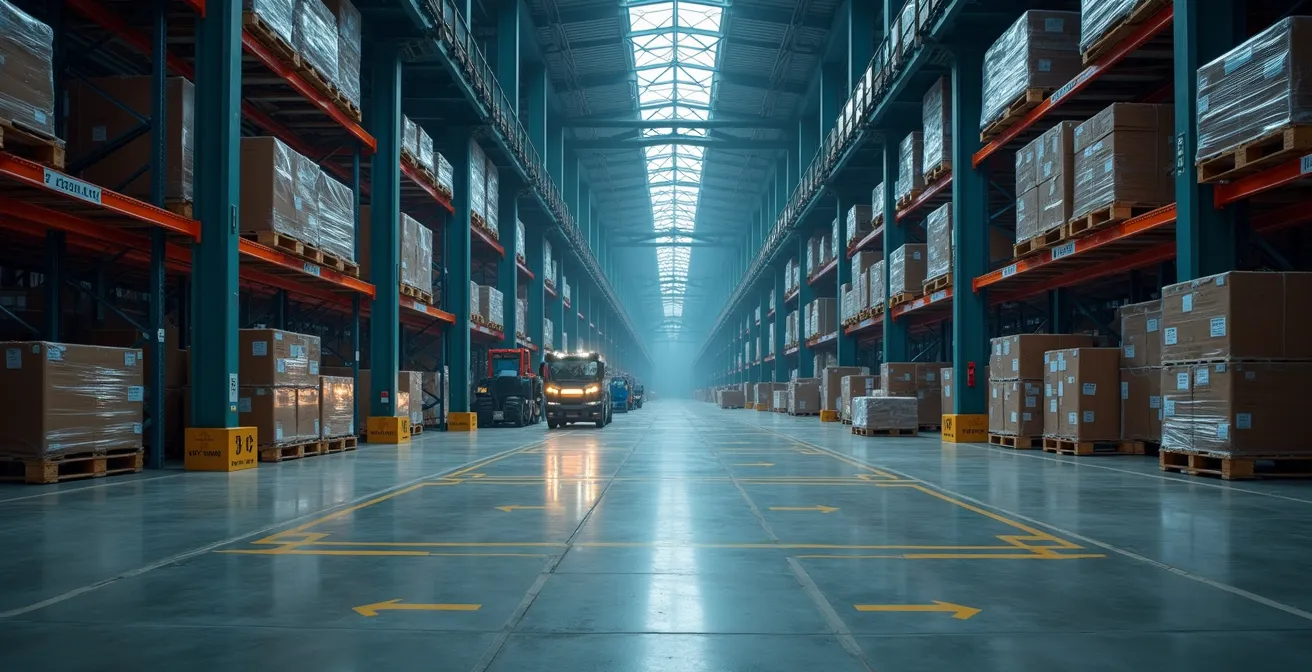
Designing for robotics isn’t just about open space; it’s about precision. As shown in the image, the entire warehouse interior becomes a system. The interaction between column spacing, racking layouts, and the pathways of automated systems must be considered holistically. A developer must think like a logistics engineer, visualizing how a tenant’s operations will flow within the space. Choosing the right column grid is a fundamental step in future-fitting a building for the inevitable rise of automation.
Why Warehouses Are Outperforming Retail Centers in the E-commerce Era?
The divergence between industrial and retail real estate is one of the most significant trends of the past decade. While struggling retail centers face vacancies and declining rents, demand for warehouse space continues to surge. The primary driver is obvious: the structural shift from in-store purchases to online ordering. E-commerce simply requires more logistics space—up to three times more, by some estimates—than traditional retail to store inventory, process orders, and manage shipments.
The scale of this shift is staggering. In a market where a recent analysis shows B2C deliveries contribute 70% of all revenue in the last-mile sector, warehouses have become the new storefronts. They are the critical infrastructure underpinning the entire digital economy. This demand is not just for massive, one-million-square-foot distribution centers in remote locations; it’s increasingly for smaller, urban infill sites that can facilitate the rapid, same-day delivery that consumers now expect. These last-mile facilities are commanding some of the highest rents in the entire real estate landscape.
However, there’s a more nuanced and powerful factor at play that many developers overlook: the reverse logistics boom, or the “returns economy.” Processing the massive volume of e-commerce returns is a complex and space-intensive operation. This has created a secondary, highly resilient demand for industrial space that retail centers are completely unequipped to handle. As one industry leader astutely observed:
The returns economy – processing e-commerce returns – creates a secondary, highly resilient demand for industrial space that retail centers cannot capture.
– Stephanie Rodriguez, Colliers National Director of Industrial Services
This dual-stream demand—for both outbound fulfillment and inbound returns—gives industrial assets a fundamental resilience that retail lacks. For a developer, this means you are investing in a sector supported by the two most powerful forces in modern commerce: the consumer’s desire for instant gratification and their habit of returning what they buy. This creates a durable competitive advantage that is set to last for the foreseeable future.
Why 60% of New Developments Go Over Budget Before Breaking Ground?
For any developer, budget overruns are a constant threat, but in industrial development, the most significant financial damage often occurs before construction even begins. The statistic that a majority of projects are over budget before groundbreaking highlights a critical failure in the pre-construction and design phases. This isn’t about unexpected material price spikes during the build; it’s about a fundamental misunderstanding of the true costs and complexities involved in planning a Class A industrial facility.
The primary source of these overruns is underestimation in a few key “soft cost” areas. Developers new to the sector often fail to budget adequately for design and architectural fees, which can run 5-10% of the total budget and increase significantly if the project involves heavy customization or technology integration. Similarly, the costs for permits, inspections, and compliance are frequently underestimated, often requiring a budget of 3-5% and involving long, unpredictable timelines that add carrying costs.
Another major pitfall is failing to account for specialized features early in the design phase. Adding requirements for heavy-duty, hyper-flat flooring ($3-10/sqft), temperature-controlled environments ($20-50/sqft), or enhanced fire suppression systems ($1-3/sqft) late in the process can cause cascading changes that blow the budget. In a volatile market, where current construction costs indicate an average of $80-$150 per square foot for a basic shell, these additions can be devastating. Furthermore, regional variations in labor costs, which can account for 20-30% of the total budget, are often not researched with enough granularity.
To combat this, successful developers are increasingly adopting collaborative project delivery models like Early Contractor Involvement (ECI) or Progressive Design-Build. These approaches bring the general contractor into the process during the design phase, providing real-time cost feedback and price certainty long before breaking ground. This prevents the costly redesigns and value engineering exercises that plague so many projects, ensuring the budget is realistic from day one.
Key Takeaways
- Class A industrial is defined by performance metrics (clear height, column spacing, power) that enable automation and logistics velocity.
- True last-mile sites are identified by their ability to reduce transport costs and support high-throughput delivery operations, not just proximity.
- De-risk projects by conducting hyper-diligent environmental checks and securing build-to-suit agreements or adopting ECI models for budget certainty.
How to Design “Robot-Ready” Buildings to Attract Next-Gen Logistics Tenants?
The ultimate goal for a modern industrial developer is to create a “robot-ready” facility. This goes far beyond simply providing an empty shell; it means engineering a building from the ground up to be the optimal environment for automation. Attracting next-generation logistics tenants who rely on robotics requires a holistic design philosophy that considers power, data, flooring, and structural layout as a single, integrated system. This is the essence of “future-fitting” an asset for the tenants you want, not just the tenants you have.
A robot-ready building is distinguished by several key features. It must have hyper-flat floors with extremely tight FF/FL (F-Number) tolerances, as even minor variations can disrupt the precision movements of autonomous mobile robots. Power infrastructure is another critical element; these facilities require massive electrical capacity to run conveyor systems and robotics, as well as robust infrastructure to support fleets of electric vehicle charging stations. Finally, data infrastructure is paramount. This includes providing private 5G-readiness and conduits for edge computing nodes, allowing tenants to process vast amounts of data with minimal latency right on site.
Case Study: Amazon’s Next-Gen Fulfillment Center
Amazon’s $325 million fulfillment center in Bessemer, Alabama, is a prime example of a robot-ready facility. It features a four-level automatic retrieval and sortation system with over 22 miles of conveyor belts capable of processing more than 100,000 items daily. Critically, this extreme automation does not eliminate human jobs; it enhances them. The facility still employs over 1,000 workers for tasks like individual item packing, necessitating parking for 1,500 vehicles. This demonstrates a crucial lesson: automation in modern warehouses often increases the need for on-site labor and the supporting infrastructure, a key consideration for site planning.
The difference between a traditional warehouse and a robot-ready facility is stark, impacting nearly every aspect of design. For a developer pivoting from residential, understanding these technical distinctions is essential for creating a competitive and profitable asset.
| Design Element | Traditional Warehouse | Robot-Ready Facility |
|---|---|---|
| Clear Height | 24-28 feet | 36-40+ feet minimum |
| Floor Specifications | Standard concrete | Hyper-flat FF/FL tolerances |
| Power Infrastructure | Basic electrical | High-capacity with EV charging |
| Data Infrastructure | Basic internet | Private 5G-ready, edge computing nodes |
| Column Spacing | 40×40 feet typical | 56×50 feet with 60′ speed bays |
The next logical step is to integrate this strategic blueprint into your site selection process and pro-forma analysis. By focusing on these non-negotiable, performance-driven specifications, you can transform your next project from a simple structure into a high-yield industrial asset, built to dominate the market for years to come.