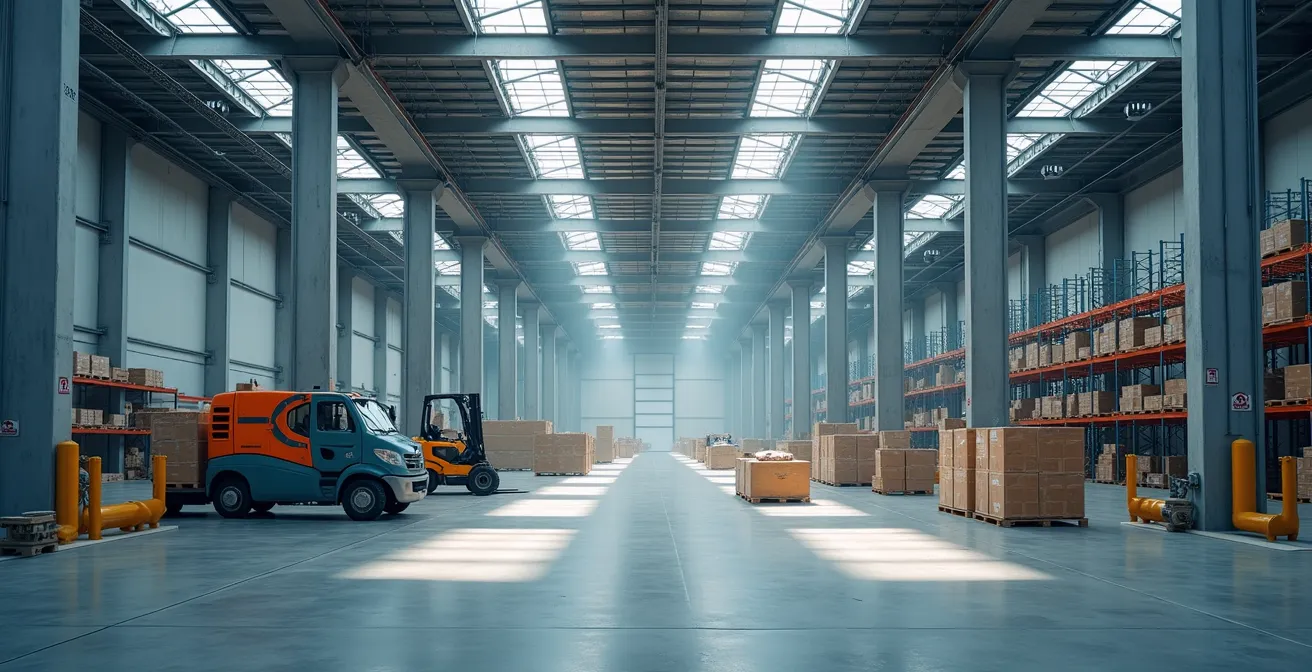
Attracting high-value manufacturing tenants requires shifting from a real estate mindset to an industrial engineering one, where the building itself becomes an integral part of their operational ecosystem.
- Structural specifications like slab thickness and clear height are not just features; they are critical enablers of advanced automation and precision machinery.
- Utility infrastructure, including power modularity and smart systems, directly impacts a tenant’s operating expenses and production uptime.
Recommendation: Proactively engineer your facility’s core systems—foundation, power, and layout—to solve a manufacturer’s core problems of throughput and operational cost, thereby creating a premium, high-demand asset.
For landlords, the industrial real estate market is no longer about providing a simple roof and four walls. The most lucrative tenants—those in advanced manufacturing, robotics, and high-tech logistics—are not just looking for space; they are seeking an operational partner. They scrutinize a building’s specifications with the same rigor they apply to their own production equipment. A standard, speculatively built warehouse often fails this test, leading to longer lease-up times and lower rental rates. The common approach of offering a generic “box” and hoping it fits is becoming obsolete.
Most property owners focus on location, square footage, and basic amenities. While important, these factors are merely the table stakes. The real value lies in the engineering decisions made long before a tenant ever tours the facility. It’s about understanding the deep operational needs of modern manufacturing. This means moving beyond thinking about “heavy power” and starting to design for power modularity and quality. It means looking past a simple “high ceiling” and planning for volumetric cube utilization with specific automation systems in mind. The difference between a vacant property and a fully-leased, premium asset is often found in these engineering details.
This guide abandons the traditional real estate checklist. Instead, we will adopt the perspective of an industrial efficiency engineer. We will dissect the critical building components that directly impact a manufacturer’s productivity and profitability. The central thesis is this: a building is not a passive container but an active part of the manufacturing process. By engineering an integrated operational ecosystem, you can design a facility that doesn’t just house a tenant’s operations but actively enhances them. We will explore how specific choices in foundation, power, layout, and building systems create undeniable value that sophisticated tenants will compete for.
This article breaks down the essential engineering considerations that transform a standard industrial building into a high-performance manufacturing facility. The following sections provide a detailed roadmap for making strategic investments that deliver maximum tenant value and landlord returns.
Contents: Designing an Industrial Facility for Peak Tenant Performance
- Why Heavy Manufacturing Tenants Reject Buildings With Standard Slab Thickness?
- How to Bring Heavy Power to an Older Industrial Building for Value-Add?
- Cross-Docking or Single-Side: Which Layout Maximizes Throughput for Tenants?
- The “Low Ceiling” Trap That Makes Your Warehouse Obsolete for Modern Racking
- How to Install Solar Arrays to Offset High Energy Costs for Manufacturers?
- Why 32-Foot Clear Height is the New Minimum for Institutional Tenants?
- How to Use AI-Driven Lighting and Cooling to Slash Utility Bills?
- How to Use IoT Tech to Reduce Industrial Operating Costs by 15%?
Why Heavy Manufacturing Tenants Reject Buildings With Standard Slab Thickness?
A building’s foundation is the literal base of a tenant’s operation, and for manufacturers, its design is non-negotiable. A standard 4-to-6-inch slab, suitable for light warehousing, is an immediate deal-breaker for any tenant utilizing heavy machinery. The issue transcends simple weight support; it’s a matter of structural load tolerance, which encompasses both static and dynamic forces. Precision equipment like CNC machines, injection molding presses, and robotic arms exert immense point loads and, more critically, generate vibrations that can ruin product quality and damage the machinery itself.
From an engineering standpoint, the ideal slab thickness is dictated by the specific equipment. For instance, industrial flooring specialists confirm that CNC machines may require between 6 and 24 inches of concrete thickness, depending on the machine’s size and precision requirements. Simply pouring a thicker slab is a start, but sophisticated tenants also look for isolated pads—thicker, reinforced concrete sections built directly underneath heavy equipment zones—to dampen vibrations and prevent them from propagating across the factory floor.
This focus on vibration is paramount in high-tech sectors. Research shows that a thickened slab is a highly effective measure for reducing external vibrations that can disrupt sensitive processes. For example, studies in laboratory environments for precision manufacturing found that 1.0-meter thick concrete foundations demonstrated vastly superior vibration control compared to 0.7-meter alternatives. For a landlord, investing in a slab with a minimum thickness of 8 inches, with the documented capacity to pour isolated pads up to 24 inches, transforms the building from a “warehouse” into a “manufacturing-ready facility.” It’s a capital investment that directly addresses a primary operational risk for high-value tenants.
How to Bring Heavy Power to an Older Industrial Building for Value-Add?
For a manufacturer, inadequate power is equivalent to a blocked supply chain—it halts production. Upgrading an older building’s electrical system is one of the highest-impact value-add strategies, but it requires more than just increasing amperage. Tenants need heavy, reliable, and flexible power. This means addressing three key areas: capacity, quality, and distribution. A manufacturer’s power profile is complex, with massive in-rush currents when machines start up, continuous load demands, and sensitivity to voltage sags or harmonic distortions that can damage expensive electronics.
A strategic power upgrade focuses on creating a modular and resilient system. Instead of a fixed grid of outlets, the gold standard is the implementation of overhead busbar trunking systems. These are essentially power highways running along the ceiling, allowing tenants to “tap in” and install power drops exactly where their machinery is located. This power modularity is a massive selling point, as it allows them to reconfigure production lines without expensive and time-consuming electrical work. For sensitive equipment, the installation of dedicated transformers or power conditioners is also critical to ensure a clean and stable supply, preventing costly downtime.
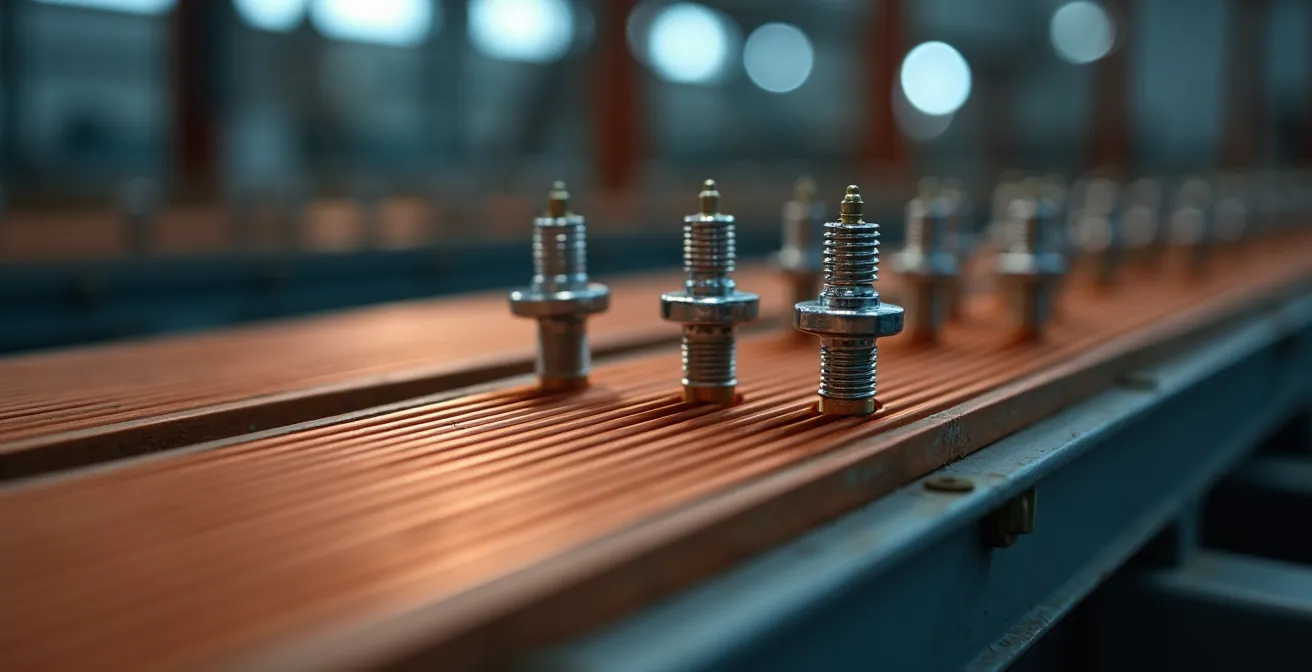
Furthermore, savvy landlords are now integrating sub-metering for different production zones. This allows tenants to track energy consumption per process, a vital tool for cost management and efficiency initiatives. A comprehensive upgrade combines these physical components with control systems like PLCs and SCADA for automated power management. By designing an electrical system that provides high capacity and clean, flexible distribution, you are not just selling power; you are selling operational uptime and adaptability. It’s a feature that directly contributes to the tenant’s bottom line.
Cross-Docking or Single-Side: Which Layout Maximizes Throughput for Tenants?
A building’s layout is the blueprint for a tenant’s entire material flow. The choice between a cross-docking configuration (docks on opposite sides) and a single-side layout (U-shaped flow) has profound implications for a manufacturer’s throughput velocity. There is no single “best” layout; the optimal choice depends entirely on the tenant’s operational model. A landlord who understands this distinction can market their property to the right user, or design a flexible space that can accommodate either.
Cross-docking facilities are designed for speed. They are ideal for tenants with fast-moving inventory that requires minimal handling—goods arrive on one side, are immediately sorted, and shipped out the other. This minimizes travel distance and handling time, making it perfect for distribution-heavy manufacturing or just-in-time operations. However, this layout can be less secure and may require a larger building footprint and more extensive yard space to manage truck circulation on two sides.
Conversely, a single-side or U-shaped layout, where shipping and receiving docks are adjacent, offers better security and centralizes dock operations. This can be more efficient for tenants whose processes involve more manufacturing or value-add steps between receiving and shipping. It consolidates supervision and equipment, but it can also create congestion if not managed properly. The table below outlines the key trade-offs.
| Feature | U-Shaped Cross-Dock | I-Shaped/L-Shaped Single-Side |
|---|---|---|
| Dock Utilization | Shared resources between shipping/receiving | Dedicated separate docks |
| Product Handling | Minimized – high cross-docking capability | More handling required |
| Best For | Fast-moving inventory, mixed velocity goods | Operations requiring heightened security |
| Space Efficiency | Most common layout type | Better for separating workflows |
| Traffic Flow | Potential congestion at shared docks | Clear separation reduces bottlenecks |
Ultimately, the discussion must extend beyond the building’s walls. As experts from REB Storage Systems point out, the external environment is just as critical. They provide a crucial perspective:
Beyond the building footprint, the critical role of the ‘truck court’ and yard management cannot be overlooked. A perfect cross-dock is useless if inefficient yard circulation creates bottlenecks outside the building.
– REB Storage Systems, 3 Warehouse Layout Patterns & Product Flows
The “Low Ceiling” Trap That Makes Your Warehouse Obsolete for Modern Racking
Clear height is one of the most frequently marketed features of an industrial building, but many landlords fall into the “low ceiling” trap by underestimating modern requirements. A building with a 24-foot clear height, once considered adequate, is now functionally obsolete for institutional-grade tenants. The reason is the drive toward volumetric cube utilization—maximizing storage and operational capacity within a given footprint. This is driven by the rise of high-density racking and automated storage and retrieval systems (AS/RS).
Today, a clear height of 32 to 36 feet is the accepted standard, with many new developments pushing toward 40 feet or more. This isn’t arbitrary; it’s dictated by the technology tenants use. Modern steel warehouses are now designed with 14-15 meter (approximately 46-49 feet) clear heights to accommodate 12-tier racking systems. Crucially, AS/RS systems require significant clearance—often 1.2 meters (about 4 feet)—between the top of the rack and the ceiling for the movement of robotic components and for maintenance access. This mechanical requirement, combined with fire suppression systems, eats into the usable vertical space.

A lower ceiling directly limits a tenant’s ability to deploy modern automation, capping their storage density and operational efficiency. For a landlord, a building with a sub-32-foot clear height automatically disqualifies a large and growing segment of the market. Investing in greater vertical space is a direct investment in the building’s future relevance. It enables tenants to install the systems that make their businesses competitive, such as high-bay racking and robotic fulfillment, making the property a far more attractive and valuable asset.
How to Install Solar Arrays to Offset High Energy Costs for Manufacturers?
Energy is a top-three operating expense for most manufacturers, making any strategy to reduce utility bills a powerful incentive. For landlords, installing a solar array is a proactive, value-add initiative that offers a compelling financial benefit to tenants while generating a new revenue stream. However, a successful solar project requires more than simply placing panels on the roof; it must be engineered as part of the building’s integrated operational ecosystem and aligned with the tenant’s specific energy profile.
The process begins with a thorough analysis. First, the roof’s structural capacity must be verified to support the additional dead load of the panels and racking. Simultaneously, a detailed study of the prospective tenant’s manufacturing energy consumption is needed to identify peak demand periods. The goal is to size the solar array and any accompanying battery storage system to specifically offset the most expensive electricity drawn from the grid during peak-rate hours. This targeted approach delivers the greatest possible savings for the tenant.
Beyond traditional rooftop arrays, landlords should evaluate alternative installations like solar carports in the parking lot or even vertical solar facades, which can be suitable for certain building orientations. From a financial perspective, a Power Purchase Agreement (PPA) is often the most attractive model. Under a PPA, the landlord (or a third-party developer) owns the solar system and sells the generated electricity to the tenant at a rate lower than the local utility, creating immediate savings for the tenant and a steady, long-term income for the building owner. This turns a cost center into a strategic asset.
Action Plan for Industrial Solar Integration
- Structural Assessment: Conduct a thorough assessment to verify the roof can support the additional dead load of solar panels and associated equipment.
- Energy Profile Analysis: Analyze the manufacturing tenant’s energy consumption profile to identify peak demand periods and size the system accordingly.
- System Sizing: Size the solar and battery storage system specifically to offset the tenant’s peak-rate electricity usage from the grid.
- Installation Evaluation: Evaluate alternative installation locations, including rooftop arrays, solar carports, and vertical building facades, for maximum generation.
- Financial Model Implementation: Implement a Power Purchase Agreement (PPA) model to structure the sale of energy to the tenant, providing them with cost savings.
Why 32-Foot Clear Height is the New Minimum for Institutional Tenants?
The 32-foot clear height standard is not an arbitrary number; it is an engineering-driven requirement dictated by the convergence of two critical systems: modern racking technology and fire suppression regulations. For institutional tenants, who prioritize safety, efficiency, and compliance, a building that fails to meet this minimum is not considered investment-grade. Understanding the interplay between these systems is crucial for any landlord aiming to attract this top-tier market segment.
The primary driver is storage density. As discussed, the rapid expansion of e-commerce has fueled demand for high-density automated racking systems. Market analysis confirms this trend, showing that over 50% of North American warehouses are expected to implement ASRS and robotics by 2032. These systems are inherently vertical. A 32-foot clear height allows for the installation of racking that supports 5 to 6 pallet levels, a significant increase over the 3 to 4 levels possible in an older, 24-foot building. This directly translates to 25-30% more storage capacity within the same footprint, a massive efficiency gain.
However, this increased height introduces a critical fire safety constraint. Taller racking requires more advanced fire suppression, specifically Early Suppression, Fast Response (ESFR) sprinkler systems. ESFR systems are designed to release large volumes of water to suppress a fire before it can grow, eliminating the need for in-rack sprinklers that obstruct storage space. Crucially, these systems have strict clearance requirements. Fire safety regulations specify that an 18-inch clearance is required between the top of the storage and the overhead sprinkler heads to ensure proper water distribution. When you factor in the sprinkler heads, pipes, and lighting fixtures, a 36-foot ceiling might only yield a 32-foot “clear” height. Therefore, 32 feet is the functional minimum to achieve modern storage density while remaining compliant with essential safety codes.
How to Use AI-Driven Lighting and Cooling to Slash Utility Bills?
After labor, utilities are often a manufacturer’s largest operating expense. Landlords who can offer a building with inherently lower energy consumption provide a direct and measurable financial advantage to their tenants. The most advanced way to achieve this is by deploying an AI-driven Building Management System (BMS) that intelligently controls lighting and HVAC (heating, ventilation, and cooling). This moves beyond simple motion sensors and programmable thermostats into a predictive and adaptive operational ecosystem.
AI-powered systems leverage data from multiple sources—occupancy sensors, production schedules, weather forecasts, and even utility rate structures—to make real-time, optimized decisions. For example, instead of waiting for a worker to enter an area, an AI can use occupancy prediction algorithms to pre-illuminate work zones just before they arrive and dim them immediately after they leave. In a large facility, this granular control eliminates enormous energy waste. Similarly, by integrating with production schedules, the HVAC system can engage in predictive pre-cooling, lowering the temperature of a high-heat-generating area just before a production run starts, using cheaper, off-peak electricity.
The impact of these smart systems is significant. Recent research on the implementation of Internet of Things (IoT) technology in commercial buildings demonstrates a clear financial benefit, showing a potential 30% reduction in energy consumption and a 20% reduction in overall operating expenses. For a landlord, investing in a smart BMS equipped with AI capabilities is a powerful differentiator. It transforms the building from a passive consumer of energy into an intelligent system that actively minimizes one of the tenant’s largest costs, delivering tangible value every month.
Key Takeaways
- A building’s foundation and power infrastructure are active components of a tenant’s manufacturing process, not passive features.
- Volumetric cube utilization, enabled by 32-foot+ clear heights, is the new metric for efficiency, replacing simple square footage.
- Smart building technologies (IoT, AI) offer a direct reduction in a tenant’s largest operating expenses, creating tangible monthly value.
How to Use IoT Tech to Reduce Industrial Operating Costs by 15%?
The promise of a 15% reduction in operating costs is a compelling proposition for any manufacturing tenant. This level of savings is achievable through the strategic implementation of Internet of Things (IoT) technology, which connects a building’s core systems to a central network for monitoring, analysis, and automated control. As a landlord, providing a facility that is either pre-equipped with or “ready” for IoT integration positions your asset at the forefront of the market. The global smart building market is a testament to this trend, demonstrating explosive growth that underscores the demand for intelligent, efficient facilities.
IoT technology creates a digital twin of the building’s operations, providing unprecedented insight. For a tenant, this translates into several key benefits. Predictive maintenance is a major one; sensors on HVAC units, motors, and other critical equipment can detect subtle changes in vibration or temperature that signal an impending failure. This allows for maintenance to be scheduled before a catastrophic breakdown occurs, avoiding costly unplanned downtime. Another key area is asset tracking. IoT sensors can monitor the location and status of high-value tools, equipment, and even inventory within the facility, reducing loss and improving workflow efficiency.
Furthermore, IoT enables fine-grained environmental control that goes beyond the AI-driven systems previously discussed. It allows for the monitoring of air quality, humidity, and other parameters critical for sensitive manufacturing processes, such as in the electronics or pharmaceutical industries. By collecting and analyzing this data, a tenant can continuously optimize their processes, reduce waste, and ensure product quality. Offering an industrial space with the backbone for these technologies—robust Wi-Fi, fiber connectivity, and designated pathways for sensor wiring—is no longer a luxury. It is a fundamental requirement for attracting and retaining the advanced manufacturers who are driving the future of the industry.
To engineer a truly high-performance industrial facility, you must think like your most sophisticated tenant. By focusing on creating an integrated operational ecosystem—where the foundation, power, layout, and building intelligence work in concert—you move beyond leasing space and begin delivering tangible production efficiency. This engineering-led approach is the most effective strategy for attracting premium tenants, maximizing rental income, and creating an asset that will retain its value for decades to come.