
Success in data center investing for sophisticated individuals now hinges on exploiting strategic gaps in power, technology, and tenant niches—not competing with large funds.
- Power availability has surpassed physical location as the primary driver of asset value, creating opportunities in “power banking.”
- Future-proofing against technological shifts, particularly the move to liquid cooling, is non-negotiable to avoid creating a stranded asset.
Recommendation: Focus on creating value through ‘infrastructure arbitrage’—securing power and permits—before a single server is ever installed.
The artificial intelligence boom is fueling an unprecedented demand for digital infrastructure, and for the sophisticated real estate investor, the allure of data centers is undeniable. Yet, the barrier to entry seems monumental, dominated by institutional giants deploying billions. The conventional wisdom for smaller investors—buy data center REITs or hunt for scarce, small-scale deals—often feels like settling for crumbs.
This approach overlooks the fundamental shifts occurring within the industry. The explosion in AI workloads is not just creating more demand; it’s changing the very definition of a valuable data center asset. The true opportunity for the agile investor isn’t in trying to build a smaller version of a hyperscale facility, but in mastering the strategic intersections where power, technology, and niche tenant needs converge. It’s about creating value where large funds, due to their scale, cannot or will not operate.
This guide moves beyond the platitudes and provides an analyst’s framework for entering this lucrative market. We will dissect the actionable strategies that allow you to generate premium returns by focusing on the new fundamentals: from securing power before land, to underwriting tenants like a venture capitalist, and designing facilities that anticipate the next wave of technological innovation.
For those who prefer a visual format, the following video offers a different kind of digital-era perspective on the importance of long-term commitment and trust—principles that are surprisingly relevant in the world of infrastructure investment.
This article provides a detailed roadmap for navigating the complexities of the modern data center market. The following summary outlines the key strategic areas we will explore, from identifying undervalued assets to designing future-proof facilities.
Summary: A Strategic Guide to Non-Institutional Data Center Investment
- Why Power Availability is Now More Valuable Than Location for Data Centers?
- How to Assess the Creditworthiness of a Tech Startup Leasing Server Space?
- Wholesale Hyperscale or Retail Colocation: Which Lease Structure is Safer?
- The Cooling Tech Shift That Could Make Your Data Center Obsolete in 5 Years
- How to Pick Locations for “Edge” Data Centers Before 5G Rollout completes?
- Why Cold Storage Facilities Command a 20% Premium Over Dry Warehouses?
- The “Stranded Asset” Risk That Could Make Your Building Unsellable in 5 Years
- How to Design “Robot-Ready” Buildings to Attract Next-Gen Logistics Tenants?
Why Power Availability is Now More Valuable Than Location for Data Centers?
For decades, real estate value was dictated by “location, location, location.” In the data center world, that mantra has been decisively replaced by “power, power, power.” The voracious energy demands of AI and high-performance computing have made access to cheap, reliable, and scalable electricity the single most critical factor in site selection. A prime piece of land with inadequate power infrastructure is functionally worthless, while a remote site with a direct connection to a high-capacity substation is a potential goldmine. This paradigm shift is the foundation of infrastructure arbitrage for the non-institutional investor.
The strategy involves identifying and securing land not based on its current zoning or proximity to a city, but on its proximity to major electrical infrastructure. The goal is to control the land and, more importantly, its associated power rights. By navigating the complex process of securing power commitments from utilities, you create immense value before a single shovel breaks ground.
Case Study: Strategic Power Land Banking
An insightful analysis of market trends reveals that investors who can pre-capitalize sites, secure entitlements, or de-risk permitting through partnerships with municipalities are poised to generate premium valuations. This is especially true when dealing with hyperscalers, who prioritize speed to market above all else and are willing to pay a premium for a “shovel-ready” site with guaranteed power.
This visual below underscores the strategic importance of this approach. The most valuable asset in the frame isn’t the empty land itself, but its direct adjacency to the substation, representing a gateway to the massive power capacity required for a modern data center.
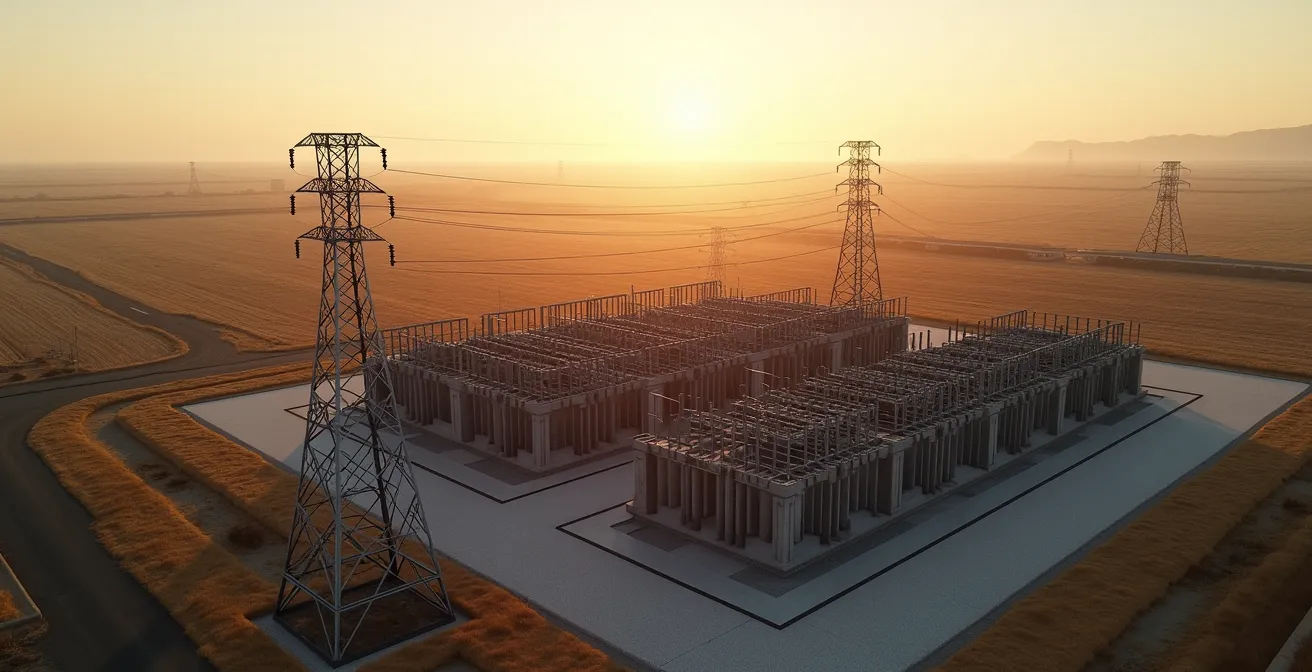
As the image illustrates, the convergence of high-voltage transmission lines near a developable plot creates the ideal conditions for a successful project. An investor who controls this intersection of land and power holds a far more valuable asset than one who simply owns a well-located but power-constrained property. This focus on the energy supply chain is the first and most crucial step in outmaneuvering larger, slower-moving capital.
How to Assess the Creditworthiness of a Tech Startup Leasing Server Space?
A significant opportunity for smaller investors lies in retail colocation, which often involves leasing space to high-growth tech startups. However, traditional real estate underwriting—relying on balance sheets and long credit histories—is utterly insufficient for evaluating a Series A company that may be pre-revenue. Assessing these tenants requires a shift in mindset from a landlord to a venture capitalist. You are not just evaluating credit risk; you are evaluating product-market fit and ecosystem value.
Instead of focusing solely on cash flow, the analysis must center on non-financial metrics that indicate traction and indispensability. A startup with deep integration into a major tech platform like AWS or a strategic partnership with a key hardware provider like Nvidia has a layer of “ecosystem credit” that a balance sheet cannot show. Their value is not in their current assets, but in their role within a larger technological supply chain. This approach requires a more dynamic and sophisticated due diligence process.
This table highlights the crucial differences between the legacy approach and the forward-looking, startup-focused assessment model necessary for success in this niche.
| Assessment Factor | Traditional Corporate Tenant | Tech Startup Tenant |
|---|---|---|
| Primary Metrics | Balance sheet, credit rating, cash flow history | Product-market fit signals, ecosystem integration, growth trajectory |
| Risk Mitigation | Standard security deposit (2-6 months) | Tiered collateral with milestone-based reductions |
| Lease Structure | Fixed long-term rates | Venture lease with equity warrants or revenue share |
| Due Diligence Focus | Financial statements, debt ratios | API usage growth, customer retention, strategic partnerships |
This venture-style approach extends to the lease structure itself. Rather than a simple fixed-rate lease, consider “venture leases” that include equity warrants or revenue-sharing clauses. This aligns your interests with the tenant’s success, allowing you to participate in their upside potential. Security deposits can also be dynamic, decreasing as the startup hits key operational or funding milestones, demonstrating their increasing stability. This credit-as-a-partnership model transforms risk into a calculated, high-reward opportunity.
Wholesale Hyperscale or Retail Colocation: Which Lease Structure is Safer?
Investors face a fundamental choice: pursue a wholesale lease with a single, credit-grade hyperscaler (like Amazon or Google) for stable, long-term income, or build a retail colocation business with multiple smaller tenants for higher potential margins. The wholesale model offers perceived safety due to the tenant’s credit rating, but it also brings concentration risk and lower returns. The retail model offers diversification and higher rates per kilowatt, but with increased management complexity and perceived tenant risk.
However, the market dynamics are shifting. The intense demand for smaller, specialized deployments has driven an incredible surge in the colocation market. Recent market analysis shows that demand is far outpacing supply, with JLL research indicating that vacancy rates hit a historic low of 3% in mid-2024 for colocation facilities. This tight market significantly de-risks the retail model, as tenant demand is exceptionally strong.
For the non-institutional investor, the optimal strategy is often a hybrid approach that balances the safety of an anchor tenant with the high margins of retail colocation. This model provides a powerful way to de-risk the investment while retaining significant upside.
The Hybrid ‘Anchor and Incubate’ Model provides a de-risking strategy where an investor secures a medium-sized anchor tenant for 50% of the space to satisfy lenders, then uses the remaining space for high-margin, diversified retail colocation tenants.
– CBRE Investment Management, Decoding Data Centers Report
This “Anchor and Incubate” strategy is perfectly suited for investors without a massive capital base. The long-term lease with the anchor tenant secures financing and provides a stable cash flow baseline. The remaining space becomes a high-margin incubator for a diverse portfolio of smaller, high-growth tenants, assessed using the venture-style underwriting discussed previously. This creates a resilient asset that combines the best of both worlds: stability and high-growth potential.
The Cooling Tech Shift That Could Make Your Data Center Obsolete in 5 Years
The single greatest technological risk facing data center investors today is the impending shift in cooling technology. For years, facilities have relied on air-based cooling (CRAC/CRAH units) to manage server heat. However, the extreme power densities of modern AI accelerators, such as Nvidia’s GPUs, are rendering air cooling insufficient and wildly inefficient. The industry is rapidly moving towards direct-to-chip liquid cooling, a technology that is far more effective at dissipating heat from high-density racks.
This isn’t a distant, futuristic threat; it’s an immediate one. A facility designed today with only air-cooling infrastructure risks becoming functionally obsolete within a few years, unable to house the next generation of high-performance computing hardware that tenants demand. The economic incentive for this shift is massive; research from the CFA Institute indicates that replacing air-based systems with liquid cooling promises to reduce cooling power usage by up to 90%. This translates directly to lower operating costs and a significant competitive advantage.
This macro photograph highlights the intricate infrastructure of a liquid cooling system, a stark contrast to the vast, open hot and cold aisles of a traditional air-cooled facility. This is the technology that will define the next decade of data center design.
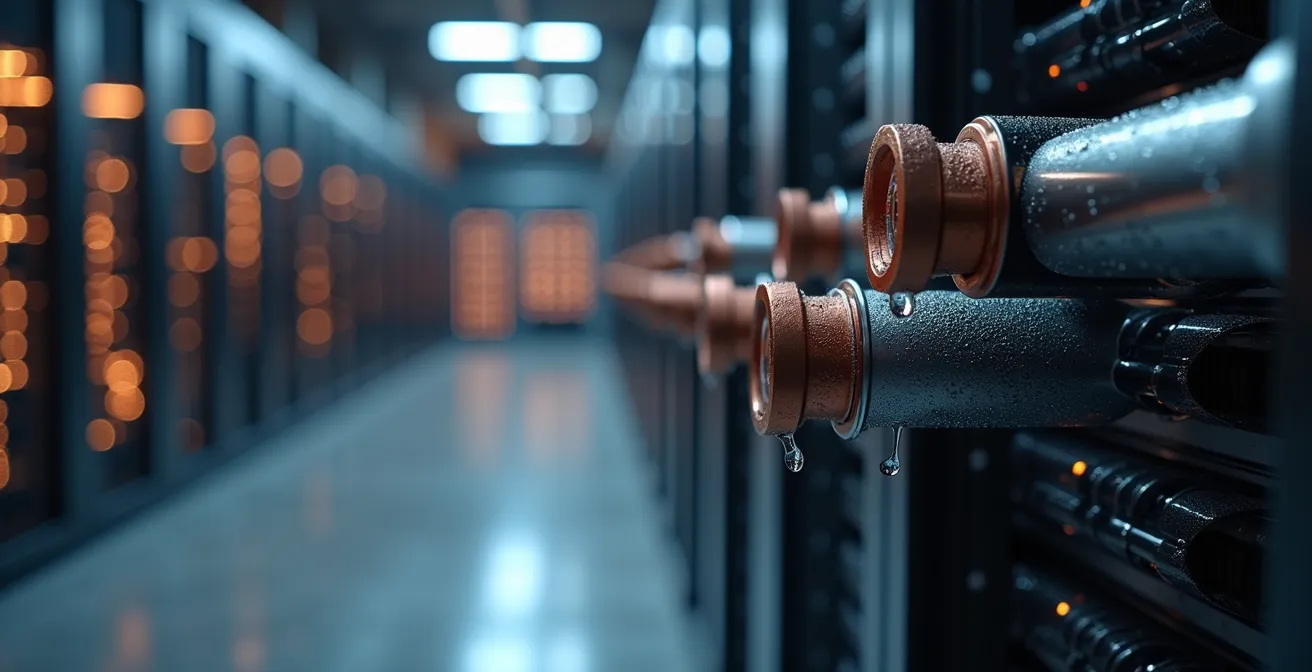
For an investor, building a brand-new facility with full liquid cooling can be cost-prohibitive. The key is planned obsolescence mitigation—designing for adaptation rather than from a static blueprint.
Case Study: Future-Proofing Cooling Infrastructure
Forward-thinking operators are now designing ‘convertible’ facilities. By incorporating elements like reinforced flooring to support the weight of liquid distribution units and higher ceilings for overhead piping, they can begin with traditional air cooling. This design allows for a phased, cost-effective transition to liquid cooling systems as tenant demand for higher power density increases, thereby avoiding the total obsolescence of the initial investment.
Failing to plan for this technological transition is the fastest way to create a stranded asset. A building that cannot support the power and cooling densities of tomorrow’s hardware will be un-leasable at any price.
How to Pick Locations for “Edge” Data Centers Before 5G Rollout completes?
While hyperscale data centers get the headlines, a massive wave of growth is occurring at the “edge” of the network. Edge data centers are smaller facilities located closer to end-users and devices, designed to process data with ultra-low latency. The common wisdom is to place these facilities near 5G cell towers. However, this is a one-dimensional view. The true opportunity lies in identifying locations that will serve the *next* generation of low-latency applications, such as autonomous robotics, IoT analytics, and smart manufacturing—before the demand becomes obvious.
Instead of just following 5G tower deployments, a more sophisticated strategy is to follow the logistics and industrial corridors. Future automated warehouses, robotic factories, and smart city infrastructure will require immense on-site computing power. Securing locations within these emerging zones positions you to capture demand that hasn’t fully materialized yet. This often involves creative adaptive reuse of existing structures, such as commercial basements, old bank vaults, or even co-locating within larger industrial facilities.
Case Study: The Municipal Franchise Approach for Edge Deployment
A novel strategy for securing prime edge locations involves partnering directly with municipalities. As cities develop ‘smart city’ initiatives, they require a distributed network of compute nodes to manage everything from traffic light sensors to emergency services connectivity. By partnering with a city, an edge operator can gain unique rights-of-way access and preferential zoning, creating a quasi-monopolistic position to serve both municipal and commercial needs in a given area.
Finding these future-proof edge locations requires a multi-layered analysis that goes far beyond a simple map of cell towers. It’s an exercise in predicting future data gravity.
Your Action Plan: Edge Location Vetting Checklist
- Follow the Flow: Prioritize sites along major logistics corridors and in proximity to automated manufacturing zones, not just generic urban centers.
- Map the Intersection: Identify physical network convergence points where long-haul fiber routes and metropolitan fiber rings intersect, ensuring robust connectivity.
- Think Adaptively: Actively target adaptive reuse opportunities such as secure bank vaults, underutilized commercial basements, and cell tower compounds for faster deployment.
- Partner for Position: Engage with municipalities on their ‘smart city’ plans to secure preferential rights-of-way and establish an entrenched position.
- Anticipate the Robots: Analyze zoning maps and economic development plans to identify future robotics and industrial IoT deployment zones that will require low-latency compute.
Why Cold Storage Facilities Command a 20% Premium Over Dry Warehouses?
At first glance, cold storage warehouses and data centers seem to belong to entirely different worlds. One houses frozen food, the other houses data. However, from an infrastructure investment perspective, they are remarkably similar. Both are mission-critical, power-intensive assets that command high tenant stickiness and premium valuations. This concept of convergent infrastructure reveals a non-obvious entry point into the digital infrastructure space.
Cold storage facilities, like data centers, require massive and redundant power systems to run their refrigeration and freezer units. They need robust, 24/7 cooling systems with multiple layers of backup. The cost to tenants of a failure—spoiled inventory—is catastrophic, much like the cost of data center downtime. This results in extremely “sticky” tenants who are reluctant to move, leading to stable, long-term revenue streams. Because of these high barriers to entry and specialized infrastructure, cold storage facilities often trade at a significant premium to standard warehouses.
The parallels are so strong that the infrastructure supporting the “cold chain” can often be leveraged or adapted to support the “data chain.” The following table from MetLife Investment Management outlines these striking similarities.
As an analysis from MetLife Investment Management shows, the operational requirements for these two asset classes have significant overlap, creating unique investment synergies.
| Infrastructure Element | Cold Storage | Data Centers | Investment Implication |
|---|---|---|---|
| Power Requirements | 5-10 MW typical | 10-100+ MW | Similar electrical infrastructure needs |
| Temperature Control | -30°C to 10°C zones | 18-27°C precision | Both require redundant cooling systems |
| Tenant Stickiness | High (frozen inventory) | High (cross-connects) | Long-term stable revenue |
| Adaptive Potential | Can house edge computing | Can add cold zones | Cross-utilization opportunities |
This convergence creates a fascinating opportunity. An investor could acquire a cold storage portfolio and leverage its robust power and cooling infrastructure to co-locate micro-data centers or edge computing nodes within the facilities.
The convergence of the cold chain and the data chain presents unique opportunities for co-locating micro-data centers within cold storage facilities to process IoT sensor data and manage automated retrieval systems.
– MetLife Investment Management, The Future of Data Centers Report 2025
This strategy allows an investor to enter the digital infrastructure market through a tangential, less competitive asset class, using existing infrastructure to build a foothold in the high-growth edge computing market.
Key Takeaways
- Power is the new gold standard: Securing a high-capacity power source is more critical than the physical address of your asset.
- Evaluate tenants like a VC: Look for ecosystem integration and growth trajectory, not just historical financials.
- Design for tomorrow’s tech: Your facility must be adaptable to future cooling and power density needs to avoid becoming a stranded asset.
The “Stranded Asset” Risk That Could Make Your Building Unsellable in 5 Years
The immense opportunity in data centers is matched by an equally immense risk: creating a stranded asset. A stranded asset is a building that, due to technological or regulatory shifts, becomes prematurely obsolete and economically unviable. In the fast-moving world of digital infrastructure, a brand-new building can become unsellable in as little as five years if it fails to anticipate the industry’s trajectory. This risk is the single biggest threat to a non-institutional investor’s capital.
The primary drivers of obsolescence are power density and cooling. As discussed, a facility that cannot support the move to liquid cooling and rack power densities exceeding 100-150kW will be unable to attract modern, high-performance computing tenants. Other factors include insufficient fiber diversity (a single point of failure for connectivity) and inflexible physical design. The stakes are incredibly high. Successful, modern data center platforms are highly sought after, with a CBRE report noting that over the last four years, acquisitions in the sector commanded premium valuations of 25x to 30x EBITDA. A stranded asset, by contrast, may be worth less than its construction cost.
Mitigating this risk requires a proactive, defensive design and leasing strategy from day one. It’s not about building for today’s requirements, but about building in the flexibility to adapt to tomorrow’s. This involves both physical design considerations and contractual safeguards with tenants.
To protect your investment, consider implementing the following strategies to maintain asset relevance and value:
- ‘Right-to-Retrofit’ Clauses: Incorporate lease clauses that allow you, the landlord, to perform necessary facility upgrades (like adding liquid cooling infrastructure) during the lease term.
- Decommissioning Bonds: Require tenants to post a bond to cover the costs of removing their specialized infrastructure at lease end, preventing you from being left with a space that’s expensive to repurpose.
- Power Density Flexibility: Design electrical systems from the outset with the capacity to scale to 150kW+ per rack, even if initial deployments are much lower.
- Fiber Diversity: Ensure the building has multiple, independent fiber entry points from different carriers to eliminate single points of failure and attract a wider range of tenants.
- Adaptive Reuse Potential: Even as a data center, consider its potential for future uses, such as a carrier hotel, disaster recovery site, or even a crypto mining facility, should the primary market shift.
By embedding this forward-looking resilience into your asset, you shift from being a passive real estate owner to an active infrastructure manager, safeguarding your capital against the relentless pace of technological change.
How to Design “Robot-Ready” Buildings to Attract Next-Gen Logistics Tenants?
The final frontier of infrastructure convergence lies at the intersection of logistics and data processing. The modern warehouse is no longer a simple box for storing goods; it is a high-tech environment teeming with sensors, autonomous mobile robots (AMRs), and sophisticated management systems. These next-generation logistics facilities are, in effect, becoming data centers themselves, and they require on-site computing power to function.
This creates a powerful opportunity to design “robot-ready” buildings that have edge computing capabilities built-in from day one. A warehouse that can offer its tenants a private 5G network and an on-site edge data center for processing robotics data with ultra-low latency has a massive competitive advantage. It allows the tenant to operate more efficiently and reliably than they could by sending data to a distant cloud server. For the investor, this means you can command premium rents and attract the most sophisticated logistics tenants.
Case Study: The Rise of On-Site Edge in Logistics
The emerging opportunity in smaller, modular data centers is particularly relevant for logistics facilities. Integrating on-site edge computing allows for the real-time processing of robotics data with ultra-low latency. This capability is no longer a luxury but a competitive necessity for warehouse operators looking to maximize automation and efficiency, creating a clear value proposition for landlords who provide it.
Designing for this convergence means thinking beyond floor loads and ceiling heights. It requires a fundamental integration of digital infrastructure into the building’s core design. An investor who builds a generic warehouse is competing on price; an investor who builds a robot-ready, data-enabled facility is competing on value.
Your design checklist for a next-generation logistics facility should include:
- Dedicated Data Space: Allocate a secure, climate-controlled space (minimum 500 sq ft) specifically for an edge data center or modular compute nodes.
- Private Network Infrastructure: Pre-install infrastructure for a private 5G network, enabling seamless, high-bandwidth communication for robots and IoT devices.
- Combined Electrical Systems: Design electrical systems to handle the combined and fluctuating loads of robot charging stations and server racks.
- Digital Twin Ready: Implement a comprehensive sensor infrastructure from day one to enable the creation of a “digital twin” of the facility for advanced operational management.
- High-Power Zoning: Plan for at least 100kW+ of available power per 10,000 sq ft of dedicated robotic operation space to meet future needs.
By embedding these features, you are not just building a warehouse; you are building a piece of mission-critical digital and physical infrastructure. This synthesis of bits and boxes represents the pinnacle of the strategies discussed, transforming a traditional real estate asset into a high-value technology platform.
To capitalize on these converging opportunities, the immediate next step is to begin performing a detailed power availability and zoning analysis in your target industrial and logistics markets. This foundational due diligence will uncover the hidden gems where digital demand and physical infrastructure are set to collide.