
The key to high returns in revitalizing neighborhoods is not spotting the first hipster café, but scientifically decoding the “path of progress” through municipal data before it’s common knowledge.
- Genuine revitalization is backed by allocated capital budgets and major infrastructure projects, not just political promises.
- Your entry point—Pioneer, Settler, or Homesteader—defines your risk and reward, a strategic choice based on verifiable data triggers.
Recommendation: Master the art of “grant stacking” by combining local, state, and federal incentives to immediately amplify your property’s value and de-risk your investment.
For the adventurous investor, the greatest returns lie on the frontier of change. The common wisdom is to look for the cliché signs: a new artisan coffee shop, a pop-up art gallery, or colorful murals appearing on brick walls. These are often cited as the harbingers of gentrification. While not entirely wrong, this surface-level observation is a lagging indicator. By the time the national coffee chain arrives, the smart money has already been made, and you’re just paying the premium.
The real art of the gentrification scout is not in spotting the effects, but in predicting the cause. It’s about moving from anecdotal observation to data-driven analysis. The true potential of a neighborhood isn’t written in latte foam; it’s buried in municipal budget documents, zoning applications, and building permit statistics. These are the data streams that reveal a city’s true intentions and financial commitments. Success in this game means learning to distinguish between political “master plans” and funded “capital improvement budgets.”
This guide abandons the clichés and provides a strategic framework for the modern real estate scout. We will not focus on the froth, but on the foundation. The central thesis is this: you can systematically de-risk high-return investments by learning to read the DNA of urban revitalization. It’s about understanding the timing of your entry, identifying the real drivers of change, and leveraging the very programs cities use to ignite this progress.
This article will equip you with the tools to become a true scout. We will explore how to interpret the early signals, verify the substance behind city plans, manage the inherent risks of a “false dawn,” and ultimately, use tax incentives and grants to engineer value from day one. Prepare to map the path of progress before the rest of the market even knows where to look.
Summary: A Scout’s Playbook for Urban Revitalization Investing
- Why Coffee Shops and Art Galleries Predict Property Value Spikes?
- How to Verify if City Regeneration Plans Are Real or Just Political Talk?
- Being the First Investor or Waiting for Proof: Which Risk Profile Wins?
- The “False Dawn” Trap Where Revitalization Stops Halfway
- How to Make Tenants Feel Safe in a Neighborhood That Is Still Rough?
- How to Draw the “Path of Progress” Line to Buy Cheaply on the Outskirts?
- Why Cities Offer 10-Year Tax Abatements to Developers?
- How to Identify City Grants That Instantly Boost Your Property’s Value?
Why Coffee Shops and Art Galleries Predict Property Value Spikes?
The appearance of an independent coffee shop or a fledgling art gallery is a classic “first wave” indicator. It’s not that these businesses cause gentrification; they are a symptom of an underlying demographic shift. These establishments cater to the “Pioneers”—artists, students, and young professionals—who are priced out of established neighborhoods and are willing to trade polished amenities for affordability and authenticity. They are the canaries in the coal mine, signaling that a new demographic sees value where others see neglect. Their presence suggests a critical mass of creative and cultural capital is forming, which inevitably attracts further investment.
However, relying on this signal alone is amateur. A true scout quantifies this “vibe.” You must differentiate between a single struggling cafe and a genuine trend. Look for a sudden drop in commercial vacancy rates, a spike in Google searches for the neighborhood’s name plus terms like “apartments” or “restaurants,” and a notable increase in building permits being filed. The quality of these new establishments also tells a story: an independent coffee shop is an early signal, a third-wave roaster indicates mid-stage development, and the arrival of a national chain confirms the process is nearly complete and overpriced.
The real-world pattern is often a domino effect. For example, the Fountain Square neighborhood in Indianapolis showed classic gentrification patterns driven by millennials, with extreme value diversity where homes valued at $50k sat next to $350k new constructions. Critically, the adjacent Bates Hendricks neighborhood followed the exact same pattern, but lagged about two years behind. A scout who recognized the signals in Fountain Square could have moved into Bates Hendricks and acquired property at a significant discount, perfectly positioned for the coming wave.
Action Plan: Your Gentrification Signal Scorecard
- Signal Tracking: Actively monitor for a sudden drop in commercial vacancy rates and a sharp increase in building permits issued in your target area.
- Listing Analysis: Track the number of photos on real estate listings; an increase in high-quality, multi-photo listings indicates rising investment and better property conditions.
- Establishment Scoring: Create a scoring system for new businesses. An independent coffee shop might be 5 points (early), a specialized roaster 7 points (mid), and a national chain 10 points (late).
- Primary Metrics Check: Always cross-reference these “soft” signals with hard data like local crime statistics and median rent trends to confirm the market’s fundamental health.
- Cash Flow Projection: Ensure any potential property can still generate positive cash flow. In early-stage neighborhoods, a target of $700-$1,000 in monthly rent is a solid benchmark for a viable investment.
Ultimately, these early signs are your entry ticket to a deeper investigation. They give you a reason to start digging into the municipal data that will confirm whether this cultural spark has the fuel to become a financial fire.
How to Verify if City Regeneration Plans Are Real or Just Political Talk?
Every politician loves announcing a grand “Master Plan” for a neglected neighborhood. These announcements generate positive press but often lack the most critical component: funding. A scout’s job is to look past the political rhetoric and “follow the money.” The difference between a wish list and a real regeneration plan lies in the city’s Capital Improvement Budget (CIB). The CIB is where aspirations meet reality, detailing funds that have been formally allocated and bonded for specific projects over the next few years.
This is where you hunt for proof. Has a small planning grant of $100,000 evolved into a multi-million dollar implementation grant? Are there line items for tangible activities like property maintenance, site preparation, or environmental remediation by a local land bank? The scale of these commitments can be immense. For instance, research on the HOPE VI revitalization program shows $6.3 billion was awarded across hundreds of grants, leveraging tens of millions in additional private investment per project. This is the kind of financial momentum that physically reshapes a neighborhood.
This is your desk, spread with the raw intelligence of urban development. You’re not just a passive investor; you’re an analyst decoding the city’s next move.

Another key is to assess the political “champion” of the plan. Is the project central to the mayor’s or council member’s re-election campaign? A project tied to a politician’s legacy is far more likely to survive budget cuts. For the unvarnished truth, don’t be afraid to use Freedom of Information Act (FOIA) requests to obtain feasibility studies and environmental impact reports. These documents often contain a blunt assessment of a project’s real-world challenges, free from political spin. They are the ultimate lie detector test for a city’s promises.
When you can confirm that a multi-year, multi-million-dollar public investment is locked in, you’re no longer speculating on a vibe. You’re investing alongside a committed partner—the city itself.
Being the First Investor or Waiting for Proof: Which Risk Profile Wins?
There is no single “winning” strategy; there is only the right strategy for your specific risk tolerance. The key is to understand the “Three Waves of Investment” and consciously choose your entry point. Each wave offers a different balance of risk and reward, and winning is about aligning your capital with your nerve. The choice isn’t about being first, it’s about being right for you.
The “Pioneer” is the first wave. This investor enters when a neighborhood is still widely considered “bad.” Prices are at rock bottom, often below 50% of the city’s median. The risk is highest—revitalization might stall—but the potential returns are astronomical, sometimes reaching 2.5-3% monthly on acquisitions. The “Settler” represents the second wave. They wait for visible signs of change: a 25% year-over-year increase in building permits, the first trendy businesses opening. Risk is moderate, and so are the returns. Finally, the “Homesteader” is the third wave, entering a proven neighborhood with established amenities. The risk is lowest, but so is the reward, with returns often at 1% or less.
As Lisa Phillips, a seasoned Real Estate Investment coach, advises in her analysis of working-class neighborhoods, the sweet spot can be found when you “Enter when the average sale price is still below 50% of the city’s median, but building permits have increased 25% year-over-year.”
Enter when the average sale price is still below 50% of the city’s median, but building permits have increased 25% year-over-year.
– Lisa Phillips, BiggerPockets Working Class Neighborhoods Analysis
This hybrid “Pioneer-Settler” approach captures the best of both worlds: acquiring assets at a deep discount while having a data-backed confirmation that the revitalization engine has started. The following table breaks down the characteristics of each investment wave.
| Investment Wave | Market Stage | Risk Level | Entry Signal | Typical Returns |
|---|---|---|---|---|
| Pioneer | Pre-revitalization | Highest risk/reward | Price below 50% city median | 2.5-3% monthly on acquisitions |
| Settler | Visible signs of change | Moderate risk | 25% year-over-year permit increase | 1.5-2% monthly returns |
| Homesteader | Proven neighborhood | Lowest risk/reward | Established amenities present | 1% monthly or less |
Ultimately, neither profile “wins” in a vacuum. The Pioneer who can’t stomach the volatility will sell at the first sign of trouble, while the Homesteader who dreams of 3x returns will always be disappointed. Victory lies in honest self-assessment and disciplined execution of the strategy that fits you.
The “False Dawn” Trap Where Revitalization Stops Halfway
The greatest danger for a gentrification scout is the “false dawn”—a neighborhood that shows all the early signs of a turnaround, only to see the momentum stall and reverse. This is where adventurous investors get burned. A few new businesses open, property values see a small bump, but the foundational economic and political support fails to materialize, leaving early investors holding devalued assets in a neighborhood that’s now worse off, as hope has been replaced by cynicism.
This isn’t just a setback; it can be a decade-long catastrophe. According to research from Northwestern’s Kellogg School of Management, when a store closes in a disinvested neighborhood, it can be ten years before another business is willing to take that same risk. A false dawn doesn’t just pause progress; it poisons the well for future investment. Your role as a scout is to be hyper-vigilant for the “revitalization killers” that can trigger this collapse.
These killers are often political or economic. The most common is the loss of a key political champion who drove the project, or the withdrawal of a major anchor developer who was supposed to be the cornerstone of the renewal. An economic downturn that dries up development financing is another major threat. On the ground, community lawsuits that successfully halt construction or the discovery of major infrastructure problems like soil contamination can stop a project in its tracks.
This is the nightmare scenario: a project abandoned, leaving a scar on the landscape and a hole in your portfolio. It’s a stark reminder that progress is not inevitable.
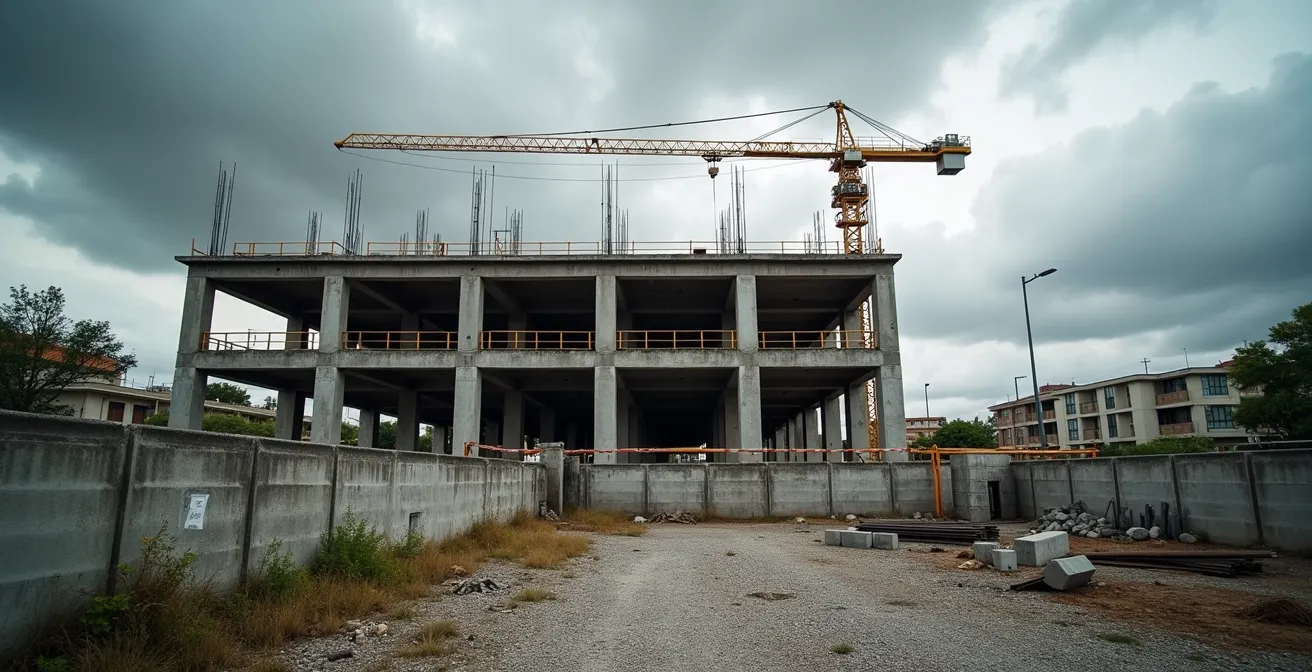
To avoid this trap, your due diligence can’t end at the time of purchase. You must continuously monitor the political landscape, the financial health of key developers, and the progress of major infrastructure projects. A scout is never complacent.
How to Make Tenants Feel Safe in a Neighborhood That Is Still Rough?
Investing in a transitioning neighborhood means you are often operating a high-quality asset in an environment that has not yet caught up. Your tenants are attracted by the value and new finishes of your property but are justifiably concerned about the “rough edges” of the surrounding area. Your primary job as a landlord isn’t just to provide housing, but to provide a sanctuary. If tenants don’t feel safe, you will face high turnover, prolonged vacancies, and a damaged reputation, erasing any potential gains from appreciation.
The solution is to adopt a proactive, multi-layered security strategy, thinking in “Concentric Circles of Safety.” * First Circle (The Unit): This is the tenant’s personal space. Harden the target with reinforced doors, high-quality smart locks, and security film on ground-floor windows. * Second Circle (The Building): Common areas must feel secure and well-maintained. This means bright, 24/7 LED lighting in hallways, a virtual doorman system, and a secure, dedicated package room to prevent theft. * Third Circle (The Property Line): The sense of safety must begin the moment someone steps onto your property. Use motion-activated floodlights, maintain clean and clear landscaping that eliminates hiding spots, and install high-visibility perimeter cameras. * Fourth Circle (The Block): Extend your influence beyond your property line. Partner with other forward-thinking landlords to fund private security patrols or collectively lobby the city for improved street lighting and police presence.
This approach does more than just deter crime; it becomes a powerful marketing tool. A case study on properties in transitioning areas shows that marketing a comprehensive security package—including features like key-fob-only access and 24/7 monitored cameras—positions the building as a “safe haven.” This allows landlords to command premium rents, often 10-15% higher than competitors. Tenants are willing to pay more for peace of mind, giving you a significant competitive advantage and attracting a higher quality of applicant during the neighborhood’s riskiest phase.
By engineering a bubble of safety, you make your property the most desirable place to live in the area, ensuring it stays fully occupied and profitable while the neighborhood around it continues its transformation.
How to Draw the “Path of Progress” Line to Buy Cheaply on the Outskirts?
The “path of progress” is the most powerful concept in revitalization investing. It’s the predictable direction in which development, demand, and value will flow outward from an established or rapidly improving core. Your mission as a scout is to map this path before it becomes obvious, allowing you to acquire properties just beyond the current “hot zone” for a fraction of the price. You aren’t buying where it’s good; you’re buying where it’s *going* to be good.
This is not guesswork; it’s data-driven cartography. Start with free GIS (Geographic Information System) tools and begin layering key city data. The most important layers are: * Approved transit extensions: New train or bus rapid transit lines are iron-clad predictors of future growth corridors. * Higher-density zoning: Map out areas the city has recently rezoned for multi-family or mixed-use development. The city is literally telling you where it wants growth to happen. * Major infrastructure projects: Pinpoint the locations of new hospitals, university expansions, or major corporate headquarters. These are “Anchor Magnets” that create thousands of jobs and pull development towards them.
Once you have these macro-level drivers mapped, you overlay the current market data. Plot the price-per-square-foot from the hot neighborhood, moving outward block by block. You will physically see the values drop. The line where you see a sudden 30% or greater price drop is the immediate frontier of opportunity. It’s the line between the “Settler” and “Pioneer” territories. By acquiring property just on the cheaper side of that line, you are positioning yourself directly in the path of predictable appreciation.
By tracking the commuting corridors between these new anchor magnets and the downtown core, you can predict the flow of development with remarkable accuracy. This method allows you to stop chasing hot neighborhoods and start letting the inevitable path of progress bring the value to you.
Why Cities Offer 10-Year Tax Abatements to Developers?
A 10-year tax abatement is one of the most powerful tools a city uses to steer private investment into specific areas. It’s a calculated economic incentive, not a giveaway. From the city’s perspective, a vacant lot or a dilapidated building generates little to no tax revenue and can be a net drain on public resources. By offering to forgive the taxes on the *new value created* by a development for a set period (typically 10 years), the city makes the investment mathematics far more attractive for a developer.
The city is making a strategic trade. In exchange for temporarily forgoing tax revenue on the new construction, it gets a host of immediate and long-term benefits. These often include specific public benefit requirements, such as the creation of a minimum number of permanent jobs (e.g., 25 or more). More importantly, the new development acts as a catalyst, kickstarting a positive feedback loop: it increases foot traffic, encourages other businesses to open, improves the perception of safety, and ultimately raises property values in the entire district. After the 10-year abatement period expires, the city gets to tax a significantly more valuable property, creating a much larger and more stable tax base for decades to come.
It’s crucial for an investor to understand the different flavors of these incentives. A tax abatement is different from a tax exemption, which forgives all property taxes, and is usually tied to stricter requirements like affordable housing quotas. The table below, based on programs like those in Houston, Texas, clarifies these distinctions.
This comparison of incentive programs illustrates the trade-offs cities make to encourage development, as seen in municipal development frameworks.
| Program Type | What’s Forgiven | Typical Duration | Minimum Investment | Public Benefit Requirements |
|---|---|---|---|---|
| Tax Abatement | Taxes on new value created | 10 years | $1M-$5M depending on area | Job creation (25+ permanent) |
| Tax Exemption | All property taxes | Varies | Higher thresholds | Affordable housing quotas, public amenities |
| PILOT Programs | Traditional tax replaced with lower payment | 5-15 years | Project-specific | Community benefits agreement |
For a scout, a designated tax abatement zone is a giant flashing sign from the city that says, “Invest here.” It’s a direct signal of where the government wants growth to occur and a financial subsidy that dramatically de-risks your investment.
Key Takeaways
- True revitalization signals are found in data (permits, budgets, search trends), not just visual cues like cafes.
- Align your investment timing (Pioneer, Settler, Homesteader) with your personal risk tolerance for disciplined success.
- Proactive, multi-layered security isn’t a cost but a revenue-driving amenity in transitioning neighborhoods.
How to Identify City Grants That Instantly Boost Your Property’s Value?
Beyond broad tax abatements, cities offer a granular menu of grants and incentives designed to solve specific problems and encourage targeted improvements. For the savvy investor, these programs are not just helpful bonuses; they are a core strategy for engineering instant value. The technique is called “grant stacking,” where you combine multiple local, state, and federal programs to fund a significant portion of your renovation, dramatically reducing your out-of-pocket costs and boosting your ROI from day one.
The key is to think of your renovation not as a single project, but as a collection of fundable micro-projects. Your strategy should be to: * Combine a city’s façade improvement grant with a state’s energy-efficiency rebate for new windows. * Layer a federal historic preservation tax credit on top if the property is in a designated historic district. * Seek out lead paint removal assistance programs, which can offer $5,000-$15,000 to mitigate this common health hazard in older buildings. * For commercial properties, apply for ADA accessibility grants to help fund ramps and other required modifications.
The impact of these stacked incentives can be monumental. In Atlanta, for example, the Urban Development Authority’s Private Enterprise Agreements (PEA) can offer up to a 100% tax exemption for projects that meet specific affordability targets. For a multifamily project with an annual tax bill of over $500,000, this incentive, combined with the use of public land, can completely eliminate land acquisition costs. This makes the project highly profitable for the investor while directly serving the community’s need for affordable housing—a true win-win that also helps address the ethical questions of development.
This approach transforms you from a passive buyer into an active partner with the city. By framing your applications to emphasize the community benefits—improved safety, blight removal, energy efficiency, accessibility—you increase your chances of approval and position your project as a model for responsible revitalization.