
Student housing yields aren’t luck; they are the direct result of a strict operational system that transforms perceived risks into predictable, high-margin returns.
- Secure 100% of rent with ironclad parental guarantor requirements, backed by their financial stake.
- Dramatically lower long-term operating expenses by choosing purpose-built designs and commercial-grade materials.
- Turn vacancies and underutilized spaces into new revenue streams through strategic leasing and densification.
Recommendation: Adopt the mindset of a systems operator, not a passive landlord, to unlock the full financial potential of the academic rental market.
Many investors are drawn to the high cash flow potential of student housing, only to be scared off by horror stories of property damage, late-night parties, and chasing down rent from unreliable tenants. The common wisdom is to simply rent by the bed and hope for the best. This approach is a gamble, treating the investment like a standard rental and exposing it to unnecessary risks.
The truth is, achieving double the yield of a traditional rental isn’t about luck or finding the “perfect” student tenants. It’s about implementing a rigorous, non-negotiable operational system that anticipates and mitigates every common pitfall. The key is to stop thinking like a landlord and start acting like a specialized operator. This transforms student housing from a high-maintenance headache into a predictable, recession-resistant asset class.
This guide will deconstruct that exact system. We will move beyond the basics and detail the specific strategies operators use to guarantee rent, minimize expenses, eliminate vacancy losses, and even generate revenue from sources other investors ignore. Each section provides a component of a larger machine designed for one purpose: maximizing yield while minimizing risk.
By exploring each component of this operational framework, you will understand how to structure your student housing investment for predictable success. The following sections break down the essential systems that separate amateur landlords from professional operators in this lucrative niche.
Summary: The Operator’s Playbook for High-Yield Student Housing
- Why Student Enrollment Often Increases During Economic Downturns?
- How to Secure Parental Guarantors to Ensure 100% Rent Collection?
- Purpose-Built Dorms or Converted Single Family: Which Has Lower OpEx?
- The Summer Vacancy Gap That Kills Student Housing Returns
- How to Legally Add an Extra Bedroom to Maximize Per-Head Rent?
- How to Generate Extra Revenue From Parking, Storage, and Laundry?
- How to Fit 3 Units on a Lot Previously Zoned for 1 Under New Laws?
- How to Replace a $100k Salary With Residential Rental Income?
Why Student Enrollment Often Increases During Economic Downturns?
One of the most compelling features of student housing as an asset class is its counter-cyclical nature. While traditional real estate often suffers during economic recessions, student housing has historically demonstrated remarkable resilience. When the job market weakens, many individuals choose to either return to school to gain new skills or remain in academia longer to ride out the storm and delay loan repayments. This behavior directly boosts university enrollment rates precisely when other sectors are contracting.
This isn’t just a theory; it’s a proven market dynamic. Historical data shows a clear divergence in performance during downturns. For instance, during the Great Recession, a period of significant economic stress, student housing performance stood in stark contrast to conventional apartments. An analysis of publicly traded real estate investment trusts (REITs) from 2008 to 2010 found that student housing REITs saw an 8.7% increase in same-store Net Operating Income (NOI). During that same period, conventional apartment REITs experienced a 6.3% decrease in NOI.
This resilience provides a powerful defensive moat for investors. It means that demand for your product—a bed near campus—is not only stable but can actually increase during periods of economic uncertainty. For an investor worried about market volatility, this characteristic makes student housing a uniquely strategic investment, offering a hedge against the broader economic climate that few other real estate sectors can match.
How to Secure Parental Guarantors to Ensure 100% Rent Collection?
The single greatest financial risk in student housing is non-payment of rent. Unlike professional tenants with credit histories and stable jobs, students often have neither. A professional operator does not accept this risk; they eliminate it systematically through the mandatory use of parental co-signers, or guarantors. This is a non-negotiable component of the lease agreement, transforming a high-risk tenant profile into a virtually zero-risk revenue stream.
The logic is simple and powerful: you are not just renting to the student, but to their family’s financial stability. Housing is a critical expense that parents are deeply invested in, and data confirms their significant role. A recent study showed that family income and savings contributed an average of 54% of the total funding for a student’s education. By requiring a parental guarantor, you are aligning your financial interests with the primary source of the student’s funding. The parent is legally and financially responsible for the lease, ensuring rent is paid on time, every time.
Implementing this system requires a formal process. The lease must explicitly name the parent as a co-signer, and their financial responsibility must be verified. This isn’t a handshake agreement; it’s a legally binding contract. By making this a standard operating procedure, you effectively eliminate rent default as a variable in your investment equation. The fear of chasing down rent from a 19-year-old vanishes when you have a direct line to a financially responsible adult who is equally invested in their child’s housing security.
Your Action Plan: Implementing an Ironclad Guarantor System
- Mandate Co-Signers: Make a financially responsible parental or guardian co-signer a mandatory requirement on every single lease, without exception.
- Verify Financials: Require the guarantor to provide proof of income or a credit check to confirm their ability to cover the lease obligations.
- Formalize the Agreement: Use a professionally drafted lease addendum that clearly outlines the guarantor’s legal and financial responsibilities for the entire lease term.
- Provide Digital Access: Implement a payment portal that allows both the student and the guarantor to view balances and make payments, increasing transparency and accountability.
- Create a Welcome Package: Send a professional welcome email or package to the guarantor, explaining the process, their responsibilities, and the benefits of your well-managed property.
Purpose-Built Dorms or Converted Single Family: Which Has Lower OpEx?
An investor’s profit is not just determined by revenue, but by controlling Operating Expenses (OpEx). In student housing, the type of property you choose has a monumental impact on your long-term costs. The two primary models are converting existing single-family homes or investing in Purpose-Built Student Housing (PBSA). While conversions can seem like a cheaper entry point, a systems-focused operator knows that PBSA is engineered for lower OpEx and higher durability, directly addressing fears of property damage.
Converted homes are built with residential-grade fixtures, appliances, and materials. These are not designed for the high-traffic, high-wear environment of a student rental. This leads to frequent repairs, higher maintenance calls, and constant replacement costs that eat into your NOI. Conversely, purpose-built properties are constructed with commercial-grade materials from the ground up—from flooring to plumbing fixtures—designed for durability and ease of maintenance. This is a strategic choice that minimizes surprises and operational drag.
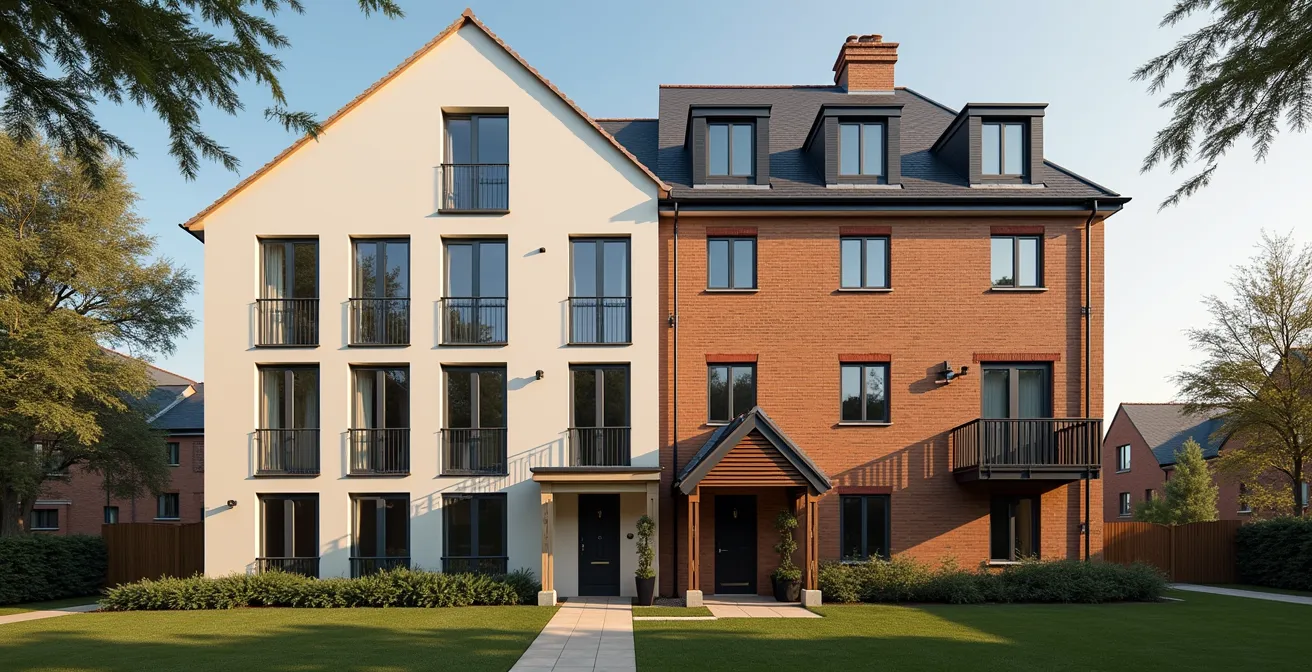
This architectural distinction translates directly into management efficiency and lower per-bed costs. A single purpose-built property offers economies of scale for everything from cleaning to security, whereas managing a scattered portfolio of converted houses is inherently less efficient. Furthermore, PBSA allows for modern solutions like sub-metering utilities, which avoids the common disputes that arise when trying to split bills in a converted home. The choice is between a reactive, high-maintenance model and a proactive, low-OpEx system.
The following table, based on an analysis of student housing investment types, breaks down the key operational differences that impact your bottom line.
| Factor | Purpose-Built Student Housing | Converted Single-Family |
|---|---|---|
| Per-Bed OpEx | Lower due to economies of scale | Higher per individual tenant |
| Maintenance Costs | Lower – commercial-grade materials | Higher – residential fixtures need frequent repairs |
| Utility Management | Sub-metering possible, RUBs systems | Complex utility splitting disputes |
| Management Efficiency | One property, centralized systems | Multiple properties, scattered management |
| Typical Occupancy | Higher density, more beds per property | 4-6 beds typical per house |
The Summer Vacancy Gap That Kills Student Housing Returns
The most predictable threat to a student housing investor’s annual return is the “summer vacancy gap.” Most student leases follow the nine-month academic calendar, leaving landlords with two to three months of zero income. For an unprepared investor, this seasonal occupancy can turn a profitable investment into a losing one. A professional operator, however, doesn’t accept this as a cost of doing business; they build a leasing system designed to eliminate seasonal vacancy entirely.
The core of this system is moving away from the academic calendar and implementing a standard 12-month lease. This might seem counter-intuitive, but it’s the industry standard for purpose-built housing and the most effective tool for stabilizing income. You are not renting a room for a semester; you are leasing an asset for a full year. Students who intend to return in the fall will sign a 12-month lease to secure their spot, even if they aren’t physically present over the summer. This provides you with uninterrupted cash flow.
For properties where 12-month leases are not feasible, or to fill any remaining gaps, a multi-pronged strategy is essential. This involves actively marketing to different demographics during the off-season. Your property near a university is also valuable to other groups in the summer. Proactive strategies include:
- Summer Session Rentals: Target students who are taking summer courses and need short-term accommodation.
- Intern and Researcher Housing: Partner with university departments or local companies to house visiting professors, researchers, or summer interns.
- Short-Term Executive Rentals: List furnished units on platforms like Airbnb or Furnished Finder, marketing them as professional or executive housing during the summer months.
- “10-for-12” Model: A hybrid model where the lease is for 12 months, but occupancy is for 10, with a slightly reduced rate to account for the summer. This still guarantees year-round income and is simpler than finding short-term tenants.
How to Legally Add an Extra Bedroom to Maximize Per-Head Rent?
In student housing, revenue is a direct function of the number of beds. A key strategy for operators, especially in converted properties, is “manufacturing” additional bedrooms out of underutilized space. This not only increases gross rental income but also has the secondary benefit of reducing large common areas that can encourage parties—a direct answer to an investor’s fear of property damage. A single extra bedroom can significantly boost a property’s cash flow, as renting by the room often yields higher returns. For instance, a property that would normally rent for $1,500/month could yield as much as 20% higher income if its three rooms are rented individually for $600 each.
However, this must be done legally and safely. Simply putting up a wall is not enough and can create dangerous living conditions and legal liabilities. A professional operator follows a strict checklist to ensure any new bedroom is compliant with local building codes. This is not a corner to be cut; it is a critical part of a responsible, long-term investment strategy.
The process involves a careful audit of the property and local regulations. Key considerations include:
- Space Conversion: Formal dining rooms, large dens, or oversized living rooms are prime candidates for conversion. The goal is to create functional, private sleeping areas while leaving adequate, but not excessive, common space.
- Egress Requirements: Every bedroom must have a proper means of escape in an emergency. This typically means a window of a specific minimum size and a door. You must verify and adhere to your local jurisdiction’s egress codes.
- Occupancy Limits: Check local zoning laws regarding the maximum number of unrelated occupants allowed in a single dwelling. Exceeding this limit can result in fines and legal action.
- HMO Licensing: In many areas, properties rented to a certain number of unrelated individuals are classified as a House in Multiple Occupation (HMO) and require a special license. This often comes with additional safety requirements, such as specific smoke detector placements and fire doors.
How to Generate Extra Revenue From Parking, Storage, and Laundry?
A sophisticated operator views a student housing property not just as a collection of bedrooms, but as a multi-faceted asset with numerous potential revenue streams. Relying solely on rent is a landlord’s mindset. An operator’s mindset involves monetizing every valuable amenity the property offers. These “ancillary revenues” can significantly increase a property’s Net Operating Income (NOI) with minimal additional investment, turning overlooked spaces and services into profit centers.
The three most common and effective sources of ancillary revenue in student housing are parking, storage, and laundry. Students, and their parents, value convenience and are willing to pay for it. By unbundling these services from the base rent, you create an à la carte model where tenants pay for what they use, directly increasing your yield. This is a core tenet of “by the bed” leasing, where affordability of the room is key, and services are bundled for additional income.
Here is how to systematize each stream:
- Parking: In any area near a campus, parking is a scarce and valuable commodity. Instead of including it for free, lease parking spaces separately on a first-come, first-served basis for a monthly fee.
- Storage: Students often have belongings they don’t need during the semester or want to store over the summer. Offer secure, on-site storage units or cages in basements or garages for a monthly fee. This also serves as an incentive for lease renewal.
- Laundry: Instead of a free-for-all, install commercial-grade, coin-operated or app-based laundry machines. This not only generates consistent income but also ensures the use of durable equipment that can handle heavy usage, reducing your maintenance burden.

These are not small-change operations; cumulatively, they can add thousands of dollars to your annual income. This approach maximizes the asset’s overall profitability and reinforces the professional, service-oriented nature of your operation.
How to Fit 3 Units on a Lot Previously Zoned for 1 Under New Laws?
For the truly ambitious investor, the ultimate strategy for maximizing yield is increasing density. This means moving beyond renting rooms in a single house to creating multiple legal rental units on a single lot. Historically, this was difficult due to restrictive single-family zoning laws. However, recent legislative changes in many states are actively encouraging the creation of Accessory Dwelling Units (ADUs), creating a massive opportunity for savvy investors to triple their income potential on one piece of land.
These new laws often override local zoning, allowing property owners to add one or even two additional rental units to a lot previously zoned for only one home. The most common strategy is a three-unit conversion on a standard single-family lot. This “development playbook” is a powerful tool for accelerating portfolio growth and profitability, and it’s becoming more accessible as the student housing market is projected to need over 9 million beds by 2031, fueling demand for this kind of densification.
A systematic approach to this strategy involves several steps:
- Research State-Level Laws: Identify state legislation (like California’s SB9) that preempts local single-family zoning and explicitly allows for ADUs and lot splits.
- Convert Existing Structures: The first step is often converting an existing garage into a Junior ADU (JADU), creating a separate, rentable studio or one-bedroom unit perfect for a student.
- Build a Detached ADU: The next step is to build a new, detached ADU in the backyard. This can be designed specifically for student living, with multiple small bedrooms and shared common areas.
- Optimize the Main House: The original home remains the primary rental unit, itself optimized for per-bed leasing by converting dens or dining rooms into extra bedrooms.
By executing this plan, you transform a single-income property into a triplex, with three separate streams of rental income from a single parcel of land. This is the pinnacle of asset optimization, turning a simple rental into a small-scale development project.
Key Takeaways
- Parental guarantors are a non-negotiable requirement for eliminating rent loss and de-risking your tenant base.
- Choosing purpose-built designs or retrofitting with commercial-grade materials drastically lowers long-term operating expenses and maintenance headaches.
- A 12-month lease structure, supplemented with short-term rentals, is the most effective system for closing the summer vacancy gap and ensuring year-round cash flow.
How to Replace a $100k Salary With Residential Rental Income?
The ultimate goal for many investors is to build a rental income stream that provides financial freedom, capable of replacing a substantial salary. The question is, how can this be achieved? As one investor, a full-time pharmacist, noted after successfully replacing his six-figure salary, it is achievable by capitalizing on the high-yield trend of student housing. The answer lies not in buying more and more properties, but in applying the rigorous operational systems we’ve discussed to a focused portfolio.
A single, well-managed student rental property, optimized for yield, can generate the cash flow of two or three traditional rentals. By implementing parental guarantors, minimizing OpEx with durable materials, solving for vacancy, adding legal bedrooms, and creating ancillary revenue streams, you are stacking multiple profit drivers onto a single asset. This systematic approach is what bridges the gap between average returns and the kind of income that can truly replace a salary.
The numbers consistently show that student housing, when operated professionally, outperforms traditional buy-to-let investments. The combination of higher per-bed rent and consistent demand creates a powerful financial engine. While the management intensity is higher, the returns are proportionally greater, making it a more efficient path to a high-income goal.
The table below provides a clear comparison of the return profiles, illustrating why a focused strategy in student housing can be the fastest route to replacing a six-figure salary.
| Investment Type | Typical Yield | Occupancy Rate | Management Intensity |
|---|---|---|---|
| Traditional Buy-to-Let | 4-8% | Year-round stability | Lower |
| Student Housing | 6-12% | Academic cycle dependent | Higher |
| Premium Student Housing | 8-10% | 93.7% average | Professional management needed |
To begin building your own high-yield student housing portfolio, the next logical step is to analyze a potential property not through a traditional lens, but through the operational systems outlined in this guide. Evaluate every opportunity based on its potential for risk mitigation and asset optimization.