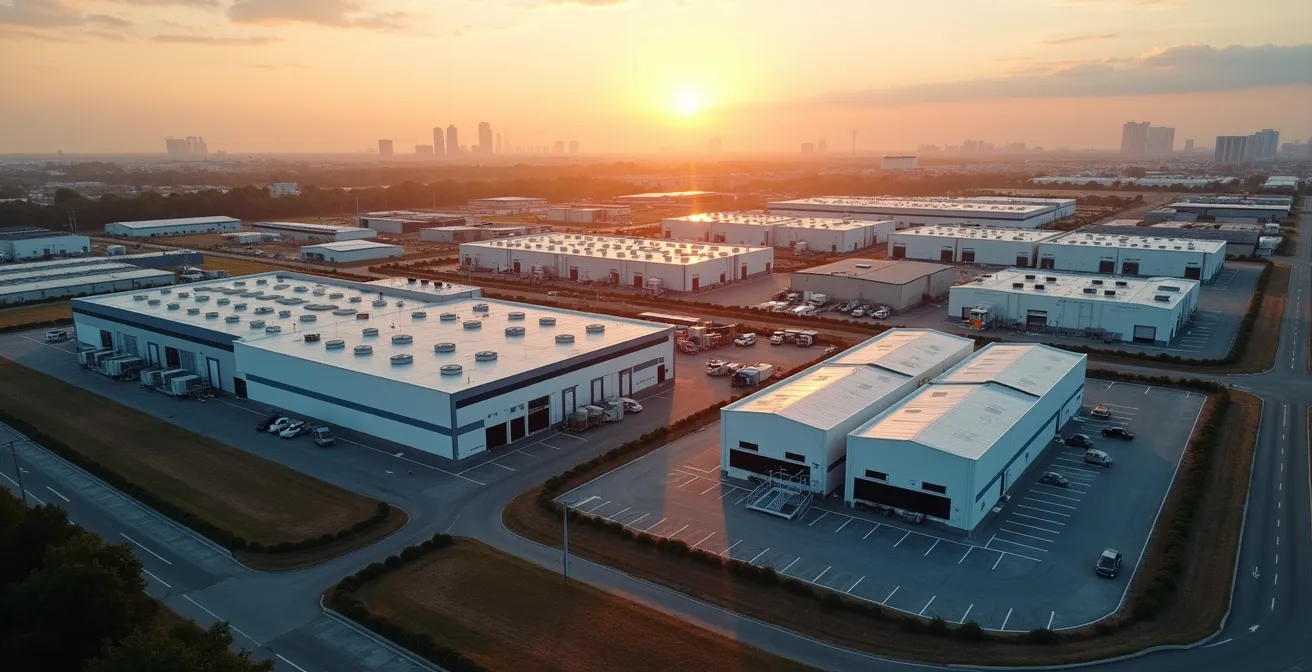
The saturated warehouse market is forcing investors to look at niche assets, but the key to higher yields isn’t just picking a trend—it’s mastering and pricing operational complexity.
- Success in assets like cold storage or data centers comes from managing higher operational costs and technical demands, which creates a barrier to entry for less sophisticated capital.
- The greatest risk, tenant-specific “structural inflexibility,” can be mitigated through strategic lease clauses, decommissioning bonds, and future-proof building design.
Recommendation: Shift your due diligence from a property-first to an operations-first mindset. Analyze the business model within the building, not just the building itself.
For the savvy real estate investor, the writing has been on the wall for some time: the general warehouse and logistics market is crowded. Cap rate compression and fierce competition from institutional giants have squeezed yields, leaving many searching for the next frontier. The conversation inevitably turns to niche industrial assets—buzzwords like cold storage, data centers, and flex space are touted as the solution for higher returns. But veteran investors know that simply chasing these trends is a recipe for disaster.
The common advice is to diversify into these less-congested markets. However, this often overlooks the fundamental shift in thinking required. These assets aren’t just “warehouses with a twist.” They are complex operating businesses housed within a real estate shell. The premium yields they offer are not a free lunch; they are direct compensation for taking on greater operational burdens and navigating significant structural risks.
This is where the real opportunity lies. The secret to successfully pivoting into niche assets isn’t about identifying the next hot sector. It’s about mastering the art of valuing operational complexity and pricing structural inflexibility to create a powerful and defensible competitive moat. It’s a move from being a landlord to becoming a strategic infrastructure partner.
This guide will deconstruct the playbook for this pivot. We will analyze the specific mechanics that drive premiums in key niche sectors, dissect the inherent risks, and provide a strategic framework for identifying opportunities and mitigating liabilities, allowing you to move beyond the crowded mainstream and into a more profitable industrial investing future.
Table of Contents: A Strategic Guide to Niche Industrial Investing
- Why Cold Storage Facilities Command a 20% Premium Over Dry Warehouses?
- How to Convert an Old Warehouse Into High-Yield Flex Space for Small Businesses?
- IOS or Covered Warehousing: Which Has Better Cash-on-Cash Returns?
- The “Special Purpose” Risk: What Happens When Your Bio-Lab Tenant Leaves?
- How to Identify “Infill” Locations That Amazon Will Desperately Need in 3 Years?
- The Risk of Owning Single-Purpose Assets Like Car Washes or Cinemas
- Why Power Availability is Now More Valuable Than Location for Data Centers?
- How to Enter the Data Center Market Without Billions in Institutional Capital?
Why Cold Storage Facilities Command a 20% Premium Over Dry Warehouses?
The significant yield premium for cold storage isn’t just about scarcity; it’s a direct reflection of higher barriers to entry and intense operational demands—a concept we can call operational arbitrage. Investors earn that premium by successfully managing complexities that deter generalist players. The first barrier is capital expenditure. Building a cold storage facility can cost two to three times more per square foot than a standard warehouse. A recent project, for example, came in at $220 per square foot, while comparable dry storage was being built for $85.
The second, and more persistent, factor is operational expenditure (OpEx), driven primarily by energy. A standard warehouse consumes 5-10 watts per square foot, but cold storage facilities are energy hogs, consuming 25-35 watts per square foot. This massive difference in utility cost requires sophisticated management systems and creates a significant financial hurdle that must be priced into the lease, thus contributing to higher rental rates.
Furthermore, the specialization within cold storage creates tiers of value. A facility isn’t just “cold”; it’s a collection of precise temperature zones, each commanding a different premium:
- Refrigerated Zone (33-55°F): The baseline for fresh produce, commanding a standard premium.
- Frozen Zone (-10-0°F): A higher premium for long-term frozen goods, requiring more robust insulation and cooling systems.
- Ultra-Low/Pharma-Grade (-80°F): The highest premium, demanded by the pharmaceutical supply chain for vaccines and biologics, which also involves stringent FDA compliance and validation.
The 20% premium, therefore, is not just rent. It is the return an investor captures for financing higher construction costs, managing extreme energy consumption, and delivering the precise, mission-critical environment that specialized tenants require. It’s a reward for mastering complexity.
How to Convert an Old Warehouse Into High-Yield Flex Space for Small Businesses?
As the industrial market evolves, many older, Class B or C warehouses with lower clear heights and less efficient layouts struggle to compete for large distribution tenants. Instead of selling at a discount, a savvy investor can pivot by converting these properties into high-yield “flex space” targeting a diversified base of small businesses. This strategy transforms an obsolete asset into a vibrant ecosystem of workshops, small-scale logistics operations, and light-manufacturing hubs.
The traditional approach of building out permanent demising walls and offices is capital-intensive and slow. A more agile and profitable method involves a modular pod strategy. This involves deploying prefabricated, self-contained office pods and workshop stations within the open warehouse shell. This approach dramatically reduces upfront costs and construction timelines, allowing the property to generate income faster.

The modular approach offers superior flexibility, a key selling point for small business tenants whose needs can change rapidly. As the illustration above suggests, these zones can be reconfigured, expanded, or removed with minimal disruption, allowing the landlord to adapt the space to market demand. The financial advantages of this strategy over a traditional, fixed build-out are compelling.
The following table breaks down the core differences, highlighting how the modular strategy minimizes capital risk while maximizing scalability and flexibility.
| Aspect | Traditional Build-Out | Modular Pod Strategy |
|---|---|---|
| CapEx Investment | $50-75 per sq ft | $25-35 per sq ft |
| Implementation Time | 6-12 months | 2-3 months |
| Scalability | Fixed layout | Phased expansion possible |
| Flexibility | Limited reconfiguration | Easy to reconfigure |
By adopting this model, an investor can achieve higher overall rental income per square foot by leasing to multiple smaller tenants rather than a single large one. This also diversifies the rent roll, reducing the risk associated with a single tenant departure.
IOS or Covered Warehousing: Which Has Better Cash-on-Cash Returns?
When evaluating niche industrial assets, investors often compare Industrial Outdoor Storage (IOS) with traditional covered warehousing. While both serve the industrial economy, they offer vastly different risk and return profiles. Covered warehousing is a familiar model: a building leased for a certain rate per square foot. IOS, which consists of paved, fenced, and lit yards for storing equipment, containers, and vehicles, presents a more compelling case for superior cash-on-cash returns in today’s market.
The primary driver for IOS’s attractive returns is its low capital expenditure basis and minimal maintenance requirements. There is no building to depreciate, no roof to repair, and no complex HVAC systems to maintain. The value is almost entirely in the land and its zoning, which is increasingly scarce in infill locations. This lean operational model allows a greater portion of the rental income to flow directly to the bottom line. In most U.S. markets, investors can expect strong performance, with data showing that IOS investments can deliver an ROI in the range of 8% to 12% annually.
This performance has not gone unnoticed. Institutional capital is now aggressively pursuing IOS, recognizing it as a critical component of the logistics supply chain. The sector’s growth has been explosive, with the IOS market now estimated to have a market value of over $200 billion. This institutional validation provides a strong indicator of the asset class’s long-term viability and potential for appreciation.
While a brand-new covered warehouse in a prime location might offer stability, the cash-on-cash returns are often compressed by high construction costs and intense competition. For an investor seeking higher yields, IOS provides a powerful alternative by monetizing a scarce resource—industrially zoned land—with a fraction of the capital and operational overhead of a traditional building.
The “Special Purpose” Risk: What Happens When Your Bio-Lab Tenant Leaves?
The high yields of special-purpose facilities like life science labs, food processing plants, or advanced manufacturing sites come with a critical trade-off: Structural Inflexibility Risk. These properties are built out with millions of dollars in tenant-specific infrastructure—specialized plumbing, ventilation, power, and clean rooms. If that single, highly specialized tenant vacates, the landlord is left with an asset that is difficult and costly to re-lease without significant demolition and retrofitting. This is the hidden liability in special-purpose investing.
A proactive investor does not avoid this risk; they price it and manage it from day one. The most effective tool for this is a robust lease agreement that includes a tenant-funded decommissioning bond. This is a non-negotiable clause for any sophisticated landlord in this space. It contractually obligates the tenant to fund the cost of returning the space to a neutral “white box” condition upon their departure, protecting the owner from a massive financial hit.
Beyond financial protection, smart design can also mitigate this risk. A “future-proofing” strategy involves designing the base building with enhanced, flexible infrastructure from the start. This might include higher ceiling clearances (a minimum of 18 feet), extra power conduit capacity, and reinforced flooring. These features make the building more adaptable for future tenants, even those from different industries, thereby reducing its dependency on a single use-case and broadening its appeal on the secondary market.
Your Action Plan for Mitigating Tenant Exit Risk
- Initial Audit: Identify all specialized, non-standard tenant fit-out elements that would require removal for a future tenant.
- Cost Estimation: Commission a third-party study to accurately estimate the cost of decommissioning these elements and returning the space to a “white box” condition.
- Lease Drafting: Embed explicit “white box” return standards into the lease agreement, leaving no ambiguity about the tenant’s responsibility.
- Bond Structuring: Require the tenant to secure a decommissioning bond or letter of credit valued at 150% of the estimated removal cost at lease signing.
- Financial Security: Mandate that the bond is backed by a highly-rated financial institution to ensure payment upon tenant departure or default.
By combining these legal, financial, and design strategies, an investor transforms the “special purpose” risk from an unknown liability into a calculated, manageable part of the investment thesis.
How to Identify “Infill” Locations That Amazon Will Desperately Need in 3 Years?
For investors looking to front-run demand, Amazon’s public strategy offers a clear roadmap. The e-commerce giant’s obsession with delivery speed is the single most important driver of its industrial real estate needs. As of the first quarter of 2024, across the 60 largest U.S. metro areas, nearly 60 percent of Prime orders were delivered same or next day. This relentless push for speed is impossible without a dense network of last-mile infill facilities.
To achieve this, Amazon has shifted from a national fulfillment model to a regionalized one. This new strategy involves eight interconnected regions across the U.S., each with its own inventory and fulfillment network. This approach has already reduced package touches by 20% and miles traveled by 19%. As of mid-2023, a staggering 76% of Amazon packages were fulfilled in-region. This tells an investor exactly where to look: not near the mega-fulfillment centers, but at the smaller, well-located industrial properties that can serve as the final spokes in these regional hubs.
So, how do you identify these future hotspots? The strategy is to think like Amazon’s logistics network planner:
- Map Major Consumption Zones: Identify high-density, high-income residential ZIP codes within a major metropolitan area. These are the end-points of the delivery chain.
- Analyze Drive-Time Radiuses: From these consumption zones, draw 30- to 60-minute drive-time radiuses. Amazon needs facilities within these rings to meet same-day and next-day promises.
- Overlay Industrial Zoning: Cross-reference these drive-time rings with areas zoned for industrial use. The overlap is your target acquisition zone.
- Prioritize Accessibility: Within the target zone, focus on properties with immediate access to major highways and arterial roads that lead directly to the residential rooftops.
By acquiring small-bay or IOS properties in these strategically identified infill locations, you are not just buying an industrial asset; you are buying a critical piece of last-mile infrastructure that the world’s largest retailers will need to lease or acquire to win the delivery wars.
The Risk of Owning Single-Purpose Assets Like Car Washes or Cinemas
The concept of “Structural Inflexibility Risk” extends far beyond industrial properties. Any real estate asset whose value is tied primarily to the success of a single, highly-specialized business operation—like a car wash, a movie theater, or a roller-skating rink—carries this inherent risk. When the business fails or the industry shifts, the owner is often left with a building that is functionally obsolete and expensive to repurpose.
A powerful way to quantify this is through a “Repurposing Difficulty Score” (RDS) framework. This evaluates an asset not on its current income, but on its convertibility. As one industry analysis puts it, the real danger is when the business’s value far outweighs the raw land value. An expert in the field framed this perfectly in the *Commercial Real Estate Investment Review*, stating:
The risk isn’t the asset type itself, but the ratio of its business value to its underlying land value.
– Industrial Real Estate Analysis, Commercial Real Estate Investment Review
This principle is the key to de-risking single-purpose assets. An investment in a car wash on a small, awkwardly shaped parcel in a secondary location is high-risk. An investment in the same car wash on a prime, corner lot with flexible zoning is much safer, because your downside is protected by the land’s alternative use value. The table below illustrates this concept by assigning a Repurposing Difficulty Score to various asset types.
This framework highlights why an IOS yard, with an RDS of 1/10, is so attractive. Its value is almost entirely in the land, making it supremely adaptable. A cinema, with its sloped floors and unique construction, sits at the other end of the spectrum.
| Asset Type | RDS Score | Conversion Complexity | Land Value Ratio |
|---|---|---|---|
| Cinema | 9/10 | Very Difficult | Low |
| Car Wash | 7/10 | Difficult | Medium-High |
| Data Center | 6/10 | Moderate | High |
| Flex Space | 2/10 | Easy | High |
| IOS Yard | 1/10 | Very Easy | Very High |
Before investing in any single-purpose asset, an investor must ask: “If the current business disappears tomorrow, what is my Plan B? What is the raw land worth, and how easily can I pivot to an alternative use?”
Why Power Availability is Now More Valuable Than Location for Data Centers?
For decades, the real estate mantra has been “location, location, location.” In the world of data centers, that has been replaced by “power, power, power.” The voracious energy appetite of AI and cloud computing has made access to massive, reliable electricity the single most critical factor in site selection, often eclipsing traditional considerations like fiber connectivity or tax incentives.
The most telling example is Northern Virginia, the world’s largest data center market. The region is effectively a victim of its own success. The grid is so constrained that the local utility, Dominion Energy, is now quoting a lead time of five years or more to obtain new power capacity for large-scale projects. This “power famine” means that a developer who owns a perfectly located, fully entitled parcel of land is still dead in the water if they can’t secure a power commitment. The land’s value is fundamentally tied to its access to megawatts.

This has led to a paradigm shift in strategy. Major operators are no longer just looking for sites; they are looking for power generation. In a groundbreaking move, AWS acquired a data center campus directly connected to Talen Energy’s Susquehanna nuclear power plant in Pennsylvania. This deal secures a massive 960 MW of stable, carbon-free power, effectively taking the local utility grid out of the equation. This is the future of data center development: co-locating with power sources.
For investors, this means the due diligence process has been turned on its head. The first call is not to the real estate broker, but to the local utility’s high-voltage engineering department. You must assess the available capacity at the nearest substation, the cost of upgrades, and the timeline for delivery. A parcel of land with a pre-existing, transferable power commitment is now one of the most valuable assets in industrial real estate, a clear example of how “value-density” has shifted from location to infrastructure.
Key takeaways
- Embrace Complexity: Higher yields in niche assets are a direct reward for managing operational and technical challenges that filter out generalist investors.
- Price the Exit: The biggest risk is a tenant-specific build-out. Always secure a decommissioning bond to protect your asset’s future adaptability.
- Value Power Over Place: For energy-intensive assets like data centers, access to reliable power is now the most critical and valuable site selection factor, surpassing traditional location metrics.
How to Enter the Data Center Market Without Billions in Institutional Capital?
The data center market can feel impossibly out of reach for the non-institutional investor, with hyperscale campuses costing billions. However, the same technological forces driving that demand are also creating smaller, accessible entry points. The global electricity demand from AI, data centers, and crypto is projected to explode, potentially reaching 800 TWh by 2026, a 75% jump from 2022. This tsunami of demand cannot be met by mega-projects alone.
The solution for the agile investor lies in the “edge.” Edge data centers are smaller, prefabricated facilities (typically sub-1MW) located in Tier 2 and Tier 3 markets. They are designed to support low-latency applications like 5G, the Internet of Things (IoT), and content delivery networks. Rather than competing with the giants for 100-megawatt sites, you can develop a 500-kilowatt facility in a secondary city that has a desperate need for local processing power.
A capital-efficient strategy to enter this market involves a “powered shell” development model and strategic partnerships. Instead of funding the entire project, the smaller investor can focus on what they do best: real estate. This involves:
- Securing a suitable site with confirmed power and fiber access.
- Developing the property to a “powered shell” status—meaning the core building, power connection, and fiber conduit are in place.
- Partnering with a major data center operator or enterprise client who then funds the final, highly-specialized interior fit-out.
Another overlooked strategy is the corporate sale-leaseback. Many corporations own and operate aging, inefficient data centers. An investor can approach these companies, offer to purchase the real estate, and lease it back to them under a professional management agreement. This provides the corporation with a capital injection and frees them from real estate management, while the investor acquires a mission-critical asset with a built-in, long-term tenant. These strategies allow investors to leverage their real estate expertise without needing billions in capital to compete at the hyperscale level.
By focusing on these niche strategies—from edge development to corporate sale-leasebacks—you can effectively participate in one of the most explosive growth sectors in real estate. The next step is to begin analyzing your local market for these specific opportunities, applying the operational-first framework to identify deals the institutional giants have overlooked.