
In summary:
- Protecting margins in an inflationary market requires proactive de-risking, not just reactive budget cuts.
- Rigorously stress-testing your pro forma against market dips is the first line of defense.
- Your choice of contract (Fixed Price vs. Cost Plus) acts as contractual armor against unforeseen cost escalations.
- Controlling scope creep and leveraging off-site construction are critical tactics for on-the-ground efficiency.
- Strategic decisions on zoning, market timing, and procurement are as crucial as on-site management.
I’ve been in this business for over two decades, and I’ve seen the same story play out time and again. A small developer starts with a pro forma showing a healthy 20% margin, full of optimism. But by the time the project is complete, rising material costs, unforeseen delays, and scope changes have whittled that profit down to single digits. The dream of a successful development turns into a fight for survival. Many will tell you the answer is simply a larger contingency fund or better negotiation with suppliers. While not wrong, this advice barely scratches the surface.
The truth is, in today’s volatile market, relying on reactive measures is a recipe for failure. Protecting your margin isn’t about weathering the storm; it’s about building a vessel that’s designed to withstand it from the start. The real key lies in a two-front strategy: radical pre-construction de-risking and deploying tactical efficiencies that larger players often deem too granular. It’s about creating a financial firewall around your numbers before a single shovel hits the ground.
This guide will walk you through the seasoned strategies I use to safeguard profitability. We won’t just talk about budgets; we’ll dissect how to stress-test your assumptions, arm yourself with the right contracts, combat the silent margin-killers like scope creep, and leverage modern construction methods to your advantage. This is the blueprint for moving from hoping for a 20% margin to engineering one.
This article breaks down the essential strategies to protect your development margins in a high-cost environment. Follow this structured guide to move from financial uncertainty to rigorous project control.
Summary: Securing Your Development Profitability
- Why 60% of New Developments Go Over Budget Before Breaking Ground?
- How to Stress-Test Your Development Pro Forma Against a Market Dip?
- Fixed Price or Cost Plus: Which Contract Protects You Better in Inflation?
- The Scope Creep Danger That Eats Your Contingency Fund in Weeks
- How to Shave 2 Months Off Your Construction Timeline Using Prefab Components?
- How to Get a Zoning Variance Approved Without Spending Years in Court?
- Speculative Build or Build-to-Suit: Which Carries Less Risk in 2024?
- How to Develop a Class A Industrial Facility in a Supply-Constrained Market?
Why 60% of New Developments Go Over Budget Before Breaking Ground?
Many developers think budget overruns are a construction-phase problem. The reality is, most projects are financially compromised long before construction begins. The primary culprit is an overly optimistic pro forma built on best-case scenarios. Developers fall in love with the potential sale price and work backward, squeezing assumptions on costs and timelines to make the numbers fit. This initial optimism is where the seeds of margin erosion are sown.
A core metric often misunderstood is the “development spread,” which is the difference between your projected yield on cost (your going-in cap rate) and the market cap rate for a similar stabilized property (the going-out cap rate). A healthy spread is your reward for taking on the development risk. When your initial cost estimates are too low or your stabilized income projections are too high, this spread is nothing but a fantasy. This is why a project can look great on paper, where typical development profit margins range between 20-25%, yet fail in reality.
The initial analysis often fails to adequately account for “soft costs”—architectural fees, permits, financing costs, and legal fees—which can balloon unexpectedly. A simple delay in permitting can trigger a cascade of added interest payments and professional fees, eating into your contingency before a single brick is laid. The budget isn’t just a number; it’s a reflection of your risk assessment. A flawed assessment at the start means your project is already over budget; you just don’t know it yet.
Ultimately, a pro forma is a hypothesis. The mistake is treating it like a guarantee. Without rigorous pre-construction de-risking and a deep, skeptical dive into every line item, your budget is built on a foundation of sand. The project is “over budget” from day one because the budget itself was never realistic.
How to Stress-Test Your Development Pro Forma Against a Market Dip?
A pro forma that only works in a perfect market is a liability. To build a resilient project, you need to create a financial firewall by actively trying to “break” your model before you commit capital. This isn’t about pessimism; it’s about identifying the precise points of failure in your plan. Stress-testing moves your analysis from a static spreadsheet to a dynamic risk management tool, showing you how much pressure your project can withstand before it becomes unprofitable.
The process involves systematically adjusting your key assumptions to model adverse scenarios. Don’t just nudge the numbers; hit them hard. What happens if interest rates jump 2% during your construction loan period? What if the lease-up takes six months longer than projected? A common and crucial test is modeling a significant drop in rental income. Can your project still cover its debt service and operating expenses if market rents fall unexpectedly? If a 10% rent decrease puts you in the red, your initial assumptions are too aggressive.
A comprehensive stress test should analyze multiple variables simultaneously, as market downturns rarely affect just one metric. The goal is to understand the compound impact of these changes on your key performance indicators, such as Net Operating Income (NOI), Debt Service Coverage Ratio (DSCR), and ultimately, your return on investment.
The following table, based on common industry practices, outlines variables to test under both mild and severe scenarios. As shown in a detailed analysis of real estate stress-testing, this structured approach reveals the true resilience of your project.
| Variable Type | Mild Scenario | Severe Scenario | Impact Area |
|---|---|---|---|
| Vacancy Rate | 5-7% increase | 10-15% increase | Net Operating Income |
| Cap Rate | 0.5% increase | 1-2% increase | Property Valuation |
| Interest Rate | 0.5% rise | 2% rise | Debt Service Coverage |
| Rent Growth | Flat growth | 10% decline | Cash Flow |
By running these scenarios, you identify your project’s breaking points. This allows you to build in bigger buffers, renegotiate terms, or even decide that the risk is too high. A project that survives this gauntlet on paper has a much higher chance of surviving it in the real world.
Fixed Price or Cost Plus: Which Contract Protects You Better in Inflation?
In a stable market, a fixed-price (or lump-sum) contract is often a developer’s best friend. It provides cost certainty and transfers the risk of overruns to the general contractor. However, in an inflationary environment, this “armor” can become a trap. When contractors face unpredictable price hikes, they build massive, often excessive, contingencies into their fixed bids to protect themselves. You end up paying a premium for risks that may never materialize.
Since early 2020, this has become a critical issue, as an analysis shows that building material costs have increased by a staggering 37.7%. In this climate, a rigid fixed-price contract can lead to adversarial relationships, as the contractor is incentivized to cut corners to preserve their vanishing margin. If costs escalate beyond their buffer, they may be forced to walk away or sacrifice quality, leaving you in a worse position.

The alternative is a cost-plus contract, where the developer agrees to pay the actual cost of labor and materials plus a predetermined fee to the contractor for their overhead and profit. This model offers transparency and flexibility. You pay for what the project actually costs, avoiding the inflated risk premium of a fixed bid. The primary downside, however, is the lack of a guaranteed maximum price. This places the risk of cost overruns squarely on your shoulders.
For a small-scale developer, the optimal solution is often a hybrid: a Cost-Plus contract with a Guaranteed Maximum Price (GMP). This model provides the transparency of a cost-plus agreement while capping your total exposure. It creates a partnership where both parties are motivated to control costs. Including a shared savings clause, where any savings below the GMP are split between the developer and contractor, further aligns incentives. This “contractual armor” is your best defense against the volatility of material pricing, balancing risk and fostering collaboration.
The Scope Creep Danger That Eats Your Contingency Fund in Weeks
Scope creep is the silent killer of development margins. It doesn’t arrive as a single, catastrophic event but as a series of small, seemingly insignificant changes that accumulate over time. A “minor” design tweak here, a “better” material substitution there—each one chipping away at your contingency fund. I’ve seen projects with a healthy 10% contingency exhausted in the first few weeks due to a poorly managed change order process. For a small developer, this is a path to financial ruin.
The danger lies in its informality. A casual conversation on-site or an undocumented request can quickly become an expectation. Without a rigid change order protocol, these requests bypass formal budget review and get executed, with the bill arriving later as a surprise. The root cause is often an incomplete or ambiguous initial scope of work. When design documents are not fully detailed before construction begins, it leaves room for interpretation and “improvement,” which are just other words for unbudgeted costs.
On any given project, materials can account for 40% to 60% of direct costs, making them a primary source of cost volatility and scope creep. A change in a specified finish or fixture can have ripple effects on procurement, installation, and other related trades. To combat this, your best weapon is a non-negotiable rule: no work proceeds without a signed and priced change order. This forces a conversation about cost and schedule impacts for every single deviation from the original plan.
Protecting your margins from scope creep requires discipline and a robust system. By implementing clear strategies from the outset, you transform scope management from a defensive reaction into a proactive part of your project controls.
Your Action Plan: Controlling Scope Creep and Protecting Margins
- Early Design Lock-In: Approve all design packages and specifications early and formally “freeze” them. Communicate to all stakeholders that changes post-lock-in will require a formal, rigorous review process.
- Centralized Tracking: Create and maintain a centralized commodity tracking log for all critical-path materials. This log should track original specs, approved substitutions, and cost impacts.
- Rigid Change Order Protocol: Establish a formal change order process. Every request must be submitted in writing, priced by the contractor, and approved by you before any work is performed. No exceptions.
- Tiered Cost Escalation Caps: In contractor agreements, implement tiered caps on cost escalations. For example, the contractor absorbs the first 2% of an increase, you split the next 3%, and anything above is subject to renegotiation.
- Incentivize Savings: Use shared savings clauses in your contracts. If the contractor finds a more efficient method or material that doesn’t compromise quality, they share in the savings, aligning their goals with yours.
How to Shave 2 Months Off Your Construction Timeline Using Prefab Components?
In real estate development, time is money—literally. Every day of construction adds to your carrying costs, primarily in the form of loan interest. For a small developer, compressing the construction timeline is one of the most powerful levers for protecting and even enhancing profit margins. While many focus on shaving dollars off material costs, saving weeks or months on the schedule can have a far greater financial impact, helping secure a final profit in the typical net margin range of 10% to 20% for developers.
One of the most effective strategies for this is the use of prefabricated or modular components. Instead of building everything from scratch on-site, elements like wall panels, bathroom pods, or even entire room modules are manufactured in a controlled factory environment. This parallel processing is the key to schedule compression. While site work and foundations are being prepared (a process that traditionally must finish before framing begins), your building’s core components are already being built indoors.
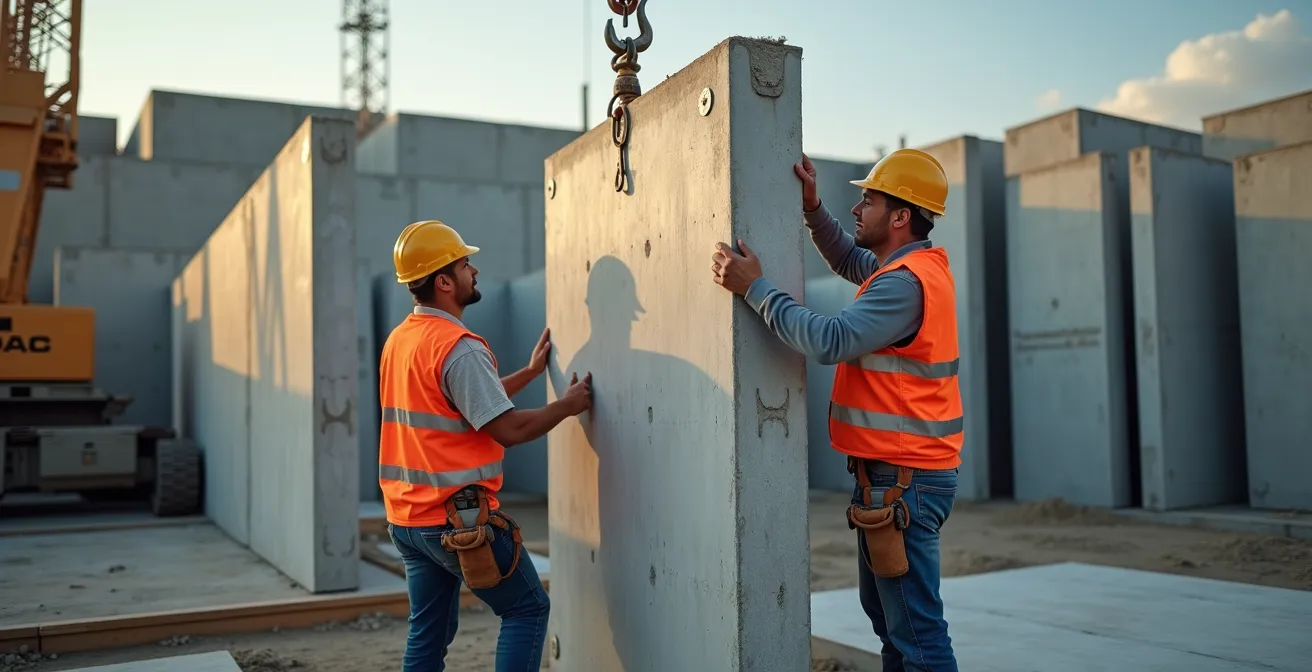
This approach offers several significant advantages beyond just speed. Manufacturing in a factory setting eliminates weather delays, a major source of uncertainty in traditional construction. Quality control is vastly superior, as components are built to precise specifications using jigs and automated equipment, reducing on-site errors and rework. Furthermore, it can significantly reduce on-site labor needs—a huge benefit in a market plagued by skilled labor shortages. Fewer workers on-site also means a safer, less congested work environment.
By moving a substantial portion of the construction process off-site, you can de-risk your schedule and accelerate your path to completion and occupancy. For a multifamily or hotel project, this might mean starting to generate revenue two or three months earlier than with conventional methods. That’s two or three months of income you wouldn’t have had, directly boosting your bottom line. It’s a prime example of a tactical efficiency that delivers strategic financial results.
How to Get a Zoning Variance Approved Without Spending Years in Court?
Many developers view zoning regulations as a frustrating roadblock—a bureaucratic hurdle to be overcome. An experienced developer, however, sees zoning as a powerful profit lever. Securing a zoning variance isn’t just about getting permission to build; it’s about unlocking hidden value in a piece of land. A variance that allows you to build a few extra units or add an additional floor can dramatically increase a project’s revenue potential with only a marginal increase in cost.
The key to success is treating the variance application not as a legal battle but as a community negotiation. Don’t lead with what you want; lead with what the community gains. Frame your request around the benefits your project provides, such as addressing a local housing shortage, improving an underutilized lot, or providing new public amenities. Commissioning high-quality renderings and impact studies that visually demonstrate these benefits can be far more persuasive than a dry legal argument.
Proactive engagement is crucial. Meet with planning department staff, neighborhood associations, and local council members long before you formally submit your application. Listen to their concerns and be prepared to make reasonable concessions. Perhaps they’re worried about parking; you can respond by incorporating more spaces than required. Maybe they’re concerned about aesthetics; you can agree to use higher-quality facade materials that align with the neighborhood character. This collaborative approach builds goodwill and turns potential opponents into supporters.
Remember, the price you pay for land is directly tied to its development potential. As one analysis of development profitability highlights, two adjacent parcels of the same size can have vastly different values if one has more favorable zoning. By successfully securing a variance, you are retroactively making the land you bought more valuable. This process requires patience and diplomacy, but the return on investment can be one of the highest in the entire development lifecycle, turning a good project into a great one without years of costly litigation.
Speculative Build or Build-to-Suit: Which Carries Less Risk in 2024?
One of the most fundamental strategic decisions a developer must make is choosing between a speculative (“spec”) build and a build-to-suit (BTS) model. This choice fundamentally alters your project’s risk profile, especially in an uncertain economic climate. A spec build involves developing a property without a tenant or buyer secured beforehand, betting that market demand will exist upon completion. A BTS project, by contrast, is custom-built for a specific tenant who has already signed a long-term lease before construction begins.
The primary advantage of a spec build is the potential for higher returns. If you time the market correctly and deliver a high-quality product in a high-demand area, you can command premium rents or a top-tier sale price. You retain full control and flexibility to adapt the building to the broadest possible market. The downside is significant: you bear 100% of the market risk. If demand evaporates or the economy sours, you could be left with a vacant, expensive building and no income to cover your debt.
A build-to-suit project is the mirror image. The risk is substantially lower because your end-user is secured from day one. That signed lease is a bankable asset, making it significantly easier to obtain construction financing on favorable terms. Your return is largely locked in and predictable. The trade-off is a lower potential upside. Since the tenant is committing early, they typically negotiate more favorable lease terms, limiting your profit margin compared to a successful spec project. You also lose flexibility, as the building is designed to one user’s specific, and potentially niche, needs.
The following table provides a clear comparison of the risk factors involved, a critical consideration for any developer. This framework, often used in commercial real estate risk analysis, helps clarify the trade-offs.
| Factor | Speculative Build | Build-to-Suit |
|---|---|---|
| Market Risk | High – dependent on future demand | Low – pre-leased tenant |
| Flexibility | High – can adapt to market | Low – locked into specifications |
| Financing | More difficult to secure | Easier with signed lease |
| Return Potential | Higher upside if market strong | Limited but predictable |
| Timeline Risk | Extended lease-up period | Immediate occupancy |
For small-scale developers in 2024, a build-to-suit or a partially pre-leased project often represents the most prudent path. It de-risks the project significantly, ensuring a stable cash flow upon completion and satisfying lenders. While the home-run potential of a spec build is tempting, the current environment of high interest rates and economic uncertainty favors the developer who prioritizes capital preservation and predictable returns.
Key Takeaways
- Proactive De-risking is Paramount: Your profit is protected before you break ground by rigorously stress-testing your pro forma and challenging every assumption.
- Your Contract is Your Armor: In an inflationary market, a hybrid contract (like a GMP) balances risk and fosters partnership better than a traditional fixed-price agreement.
- Time is Your Most Valuable Asset: Compressing the construction schedule through methods like prefabrication directly translates to lower carrying costs and higher returns.
How to Develop a Class A Industrial Facility in a Supply-Constrained Market?
Developing a high-spec, Class A industrial facility in today’s supply-constrained market is the ultimate test of a developer’s skill. It’s a high-stakes environment where the principles of pre-construction de-risking, contractual defense, and tactical efficiency are not just best practices—they are essential for survival. Success here requires a masterclass in supply chain management and strategic procurement.
The first priority is to gain control over your material supply chain. You can no longer rely on just-in-time delivery. This means moving procurement decisions to the earliest stages of project planning. As experts from the Associated Builders and Contractors note in their analysis, a key strategy is to secure long-term contracts with multiple suppliers for critical materials like steel, concrete, and roofing components. This not only helps to lock in prices but also diversifies your risk if one supplier fails to deliver.
To navigate the challenges brought on by inflation, construction companies are employing various strategies. One common approach is to secure long-term contracts with suppliers to lock in prices and mitigate the effects of future price increases. Additionally, companies may explore alternative materials or suppliers that offer better pricing options.
– Associated Builders and Contractors, 2023 Construction Sector Analysis
Value engineering also plays a crucial role, but it must be done intelligently. It’s not about substituting cheaper materials that compromise the “Class A” status of your facility. Instead, it’s about smart design choices. Can you standardize bay sizes to optimize steel usage? Can you design the foundation to use less concrete without sacrificing structural integrity? These decisions, made in collaboration with your architect and structural engineer, can yield significant savings.
Finally, leveraging technology like Monte Carlo simulations can model the compound impact of potential supply chain delays, allowing you to build more realistic timelines and contingencies. In a supply-constrained market, the developer who masters procurement and logistics is the one who delivers on time and on budget. It’s the culmination of every strategy discussed: a resilient pro forma, a collaborative contract, and a relentless focus on efficiency, all orchestrated to deliver a premier asset against the odds.
Frequently Asked Questions About Development Profitability
How do zoning changes affect project feasibility?
Changes to zoning laws or building codes can increase construction costs or limit the types of properties that can be built, directly affecting revenues and profit margins. A sudden downzoning, for instance, could render a project unfeasible overnight.
What role does land price play in profitability calculations?
The price you pay for land is one of the most critical and variable factors. While construction costs can be estimated with some accuracy, the land cost sets the foundation for your entire pro forma. Overpaying for land is a mistake that is almost impossible to recover from later in the project.
How do developers calculate the appropriate land value to pay?
Many experienced developers use a residual analysis, often called the “countdown method.” They start with the projected total sale price of the completed project and subtract all other costs (hard costs, soft costs, financing, and desired profit). The number that remains is the maximum price they can afford to pay for the land.