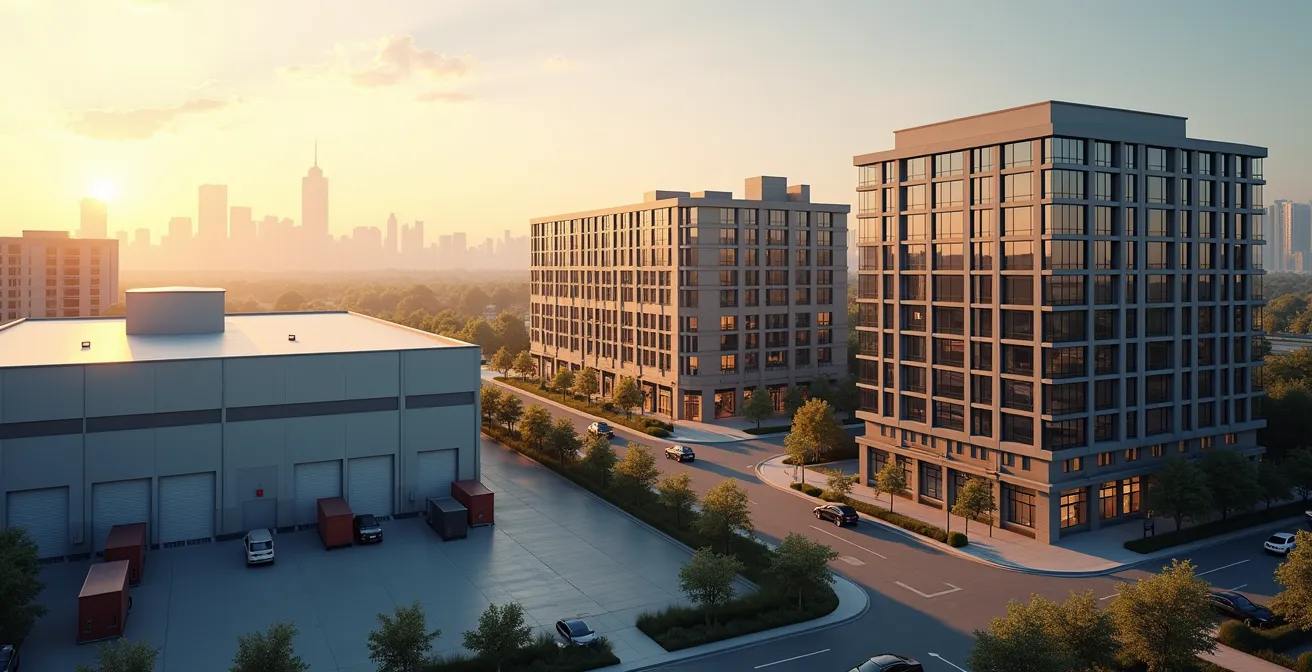
True investment risk isn’t market volatility; it’s structural obsolescence.
- E-commerce tailwinds give industrial assets a structural resilience that most retail and office properties currently lack.
- Niche assets like self-storage and data centers offer recession-proof demand streams that are decoupled from economic cycles.
Recommendation: Evaluate assets not just on today’s cap rate, but on their adaptive potential and ability to withstand systemic shifts tomorrow.
As a diversified investor with capital ready to deploy, you face a complex and rapidly shifting real estate landscape. The conventional wisdom often circles around familiar advice: focus on cap rates, analyze local market trends, and choose between the “big four”—residential, office, retail, and industrial. This approach treats risk primarily as a function of market volatility and rental income fluctuation, a perspective that is becoming dangerously incomplete.
While these metrics have their place, they often fail to account for deeper, more powerful forces reshaping the value of physical space. The rise of e-commerce, the normalization of hybrid work, and the increasing complexity of supply chains are not temporary trends; they are permanent structural shifts. An asset class that looks profitable today can become a liability tomorrow if it lacks the ability to adapt to these new realities.
But what if the true measure of risk is not just financial volatility, but structural obsolescence? This guide re-frames the analysis. We will move beyond surface-level returns to dissect the core risk profiles of various asset classes through the lens of two critical, forward-looking factors: structural resilience and adaptive potential. It’s a framework designed for strategists who understand that long-term value is built on the ability to endure and evolve.
This analysis will deconstruct the risk profiles of major and niche asset classes through this strategic lens, moving beyond surface-level metrics to uncover where the true, long-term opportunities lie. By understanding these underlying dynamics, you can make more sophisticated capital allocation decisions that are built for the future, not just for the current market cycle.
Summary: Industrial, Retail, or Residential: Which Asset Class Matches Your Risk Profile?
- Why Warehouses Are Outperforming Retail Centers in the E-commerce Era?
- How to Use a 1031 Exchange to Move From Residential to Commercial?
- Self-Storage vs Office: Which Asset Class Survives Recessions Better?
- The Risk of Owning Single-Purpose Assets Like Car Washes or Cinemas
- How Owning Both Multifamily and Retail in the Same Block Creates Synergy?
- Why Class B Office Buildings Are Facing an Existential Crisis?
- Why Cold Storage Facilities Command a 20% Premium Over Dry Warehouses?
- How to Enter the Data Center Market Without Billions in Institutional Capital?
Why Warehouses Are Outperforming Retail Centers in the E-commerce Era?
The outperformance of industrial warehousing over traditional retail is not a cyclical trend; it is a direct consequence of a permanent shift in consumer behavior. The core driver is a simple spatial equation: industry data reveals that e-commerce requires up to three times more logistics space than brick-and-mortar retail to support the same level of sales. This is due to the need for broader inventory, individual item picking, and extensive reverse logistics for processing a high volume of returns.
This structural demand provides a powerful tailwind. While retail centers grapple with rising vacancies and declining foot traffic, the logistics sector is experiencing explosive growth. Market analysis confirms this trajectory; the global warehousing market size was estimated at USD 1.01 trillion in 2023 and is projected to continue its aggressive expansion. This is not just about storing goods; it’s about powering the entire digital economy, from last-mile delivery hubs to massive fulfillment centers.
The performance metrics tell a clear story of two asset classes on diverging paths. Warehousing shows historic low vacancy rates and strong growth, while traditional retail faces significant headwinds. This table starkly illustrates the difference in market dynamics.
| Metric | Warehouse/Logistics | Traditional Retail |
|---|---|---|
| Market Size 2024 | $1.3 trillion | Declining occupancy |
| Growth Rate | 5.9% CAGR | Negative in many markets |
| Vacancy Rate | 3.2% (historic low) | Rising post-pandemic |
| Return Processing | 20-30% e-commerce returns | 8-10% in-store returns |
This fundamental imbalance in supply and demand gives industrial assets a level of structural resilience that is difficult to find in the retail sector today. Investors are not just buying a building; they are buying a critical piece of modern infrastructure.
How to Use a 1031 Exchange to Move From Residential to Commercial?
For investors looking to pivot their portfolio from residential assets toward more resilient commercial classes like industrial or self-storage, the 1031 exchange is an indispensable strategic tool. Governed by Section 1031 of the IRS code, this provision allows you to defer capital gains taxes on the sale of a property by reinvesting the proceeds into a “like-kind” property of equal or greater value. This mechanism is crucial for preserving capital and maximizing the scale of your next investment.
The term “like-kind” is interpreted broadly, meaning an investor can exchange a residential rental property for a commercial one, such as a warehouse, an office building, or a retail center. This enables a seamless transition between asset classes without an immediate tax liability eroding your investment power. However, the process is governed by strict timelines and rules that require precision and foresight. Failure to adhere to these can result in a failed exchange and a significant tax bill.
One of the most critical rules, as highlighted by tax experts, involves the value of the properties. As the team at TurboTax explains, this is a key component to a successful exchange. According to the TurboTax Tax Experts in the TurboTax 1031 Exchange Guide, “The replacement property must be of equal or greater value to avoid paying taxes immediately. Otherwise, taxes may be due on the difference (which is known as ‘boot’).” Successfully navigating this requires careful planning, which can be broken down into a clear set of steps.
Your Action Plan: The 1031 Exchange Timeline
- Engage a Qualified Intermediary: This must be done before closing on your residential property sale. The intermediary will hold the funds in escrow.
- Identify Replacement Property: You have exactly 45 days from the closing date of your sold property to formally identify potential replacement commercial properties in writing.
- Complete Commercial Due Diligence: Scrutinize the financing for the new commercial property. Lenders often require a higher down payment (typically 25-30%) for commercial real estate compared to residential.
- Close on the New Property: You must complete the purchase of the replacement property within 180 days of the original sale.
- Avoid Taxable “Boot”: Ensure the value of the replacement property and the amount of debt on it are both equal to or greater than that of the relinquished property to fully defer all capital gains tax.
By mastering this process, a 1031 exchange becomes more than a tax deferral tactic; it becomes a powerful portfolio management strategy, enabling you to pivot towards asset classes with greater structural resilience and growth potential.
Self-Storage vs Office: Which Asset Class Survives Recessions Better?
The contrast between self-storage and the traditional office market provides a masterclass in structural resilience. While the office sector is highly sensitive to economic cycles and employment trends, self-storage demand is driven by life events that are largely non-cyclical. This fundamental difference determines their performance during economic downturns.
The office market’s vulnerability has been laid bare by the rise of hybrid work and corporate downsizing. Companies are increasingly concerned about underutilization, leading to a flight to quality and leaving older buildings behind. In contrast, self-storage thrives on what the industry calls the “4 D’s”: Death, Divorce, Dislocation, and Downsizing. These are life events that occur regardless of the economic climate, creating a consistent and inelastic demand for storage space. During recessions, downsizing (both residential and commercial) can even accelerate demand.
This resilience is not theoretical. During the Great Recession, when nearly every other real estate asset class was in freefall, NAREIT data shows that self-storage delivered a positive 5% return in 2008. This remarkable performance highlights its defensive characteristics. Today, while office landlords struggle with vacancy, the self-storage sector maintains steady occupancy and reliable cash flow, proving its mettle as a truly recession-resistant asset.

As the image above starkly visualizes, the contrast is one of activity versus vacancy. While one asset class relies on a healthy, growing economy to fill its space, the other finds stability in life’s inevitable disruptions, making it a cornerstone for any risk-averse, diversified real estate portfolio.
The Risk of Owning Single-Purpose Assets Like Car Washes or Cinemas
In a rapidly evolving economy, one of the most significant, yet often underestimated, risks is investing in single-purpose assets. These are properties purpose-built for a specific use, such as a car wash, a bowling alley, or a movie cinema. Their primary vulnerability lies in their lack of adaptive potential. When the business model they were designed for falters due to technological shifts or changing consumer habits, the building itself can become a financial anchor.
The core issue is conversion cost and feasibility. Lenders are acutely aware of this risk, which is why they typically impose higher interest rates and lower loan-to-value (LTV) ratios on financing for these assets. They are pricing in the risk that if the primary tenant fails, the property may not be easily repurposed for another use, jeopardizing the collateral’s value. This financing hurdle is the first sign of high obsolescence risk.
However, not all single-purpose assets are created equal. The key differentiator is the underlying land value and the building’s structural flexibility. For example, a car wash located on a major commercial corridor often has significant adaptive reuse potential. The structure can be relatively easily demolished or converted into a quick-service restaurant, a bank branch, or another retail use, preserving the high value of its prime location. The investment is more in the land than in the specific improvement upon it.
In stark contrast, a purpose-built cinema, especially one located within a declining shopping mall, represents a far greater risk. Its specialized construction—with sloped floors, limited natural light, and specific layouts—makes conversion to another use, such as retail or office, prohibitively expensive. In many cases, the cost to adapt the space exceeds the property’s potential value after the conversion, making it a functionally obsolete asset. This is the ultimate trap of low adaptive potential.
How Owning Both Multifamily and Retail in the Same Block Creates Synergy?
While single-purpose assets carry high specialization risk, mixed-use properties represent the pinnacle of portfolio synergy. By integrating multiple asset classes—such as residential, retail, and office—within a single development, investors create a self-reinforcing ecosystem where the whole becomes far more valuable than the sum of its parts. This is not just diversification; it is strategic value creation.
The core mechanism at play is the “Amenity Premium Flywheel.” The residential component provides a captive audience for the ground-floor retail and services. This guaranteed foot traffic de-risks the retail leases, allowing landlords to attract higher-quality tenants and command premium rents. In turn, the vibrant, convenient retail environment becomes a powerful amenity for the residential units above. This allows the developer to charge 10-15% higher rents for the apartments compared to standalone multifamily buildings in the same area. This synergy creates a stable, high-occupancy environment for both asset types.

This integrated “live-work-play” dynamic is especially appealing in dense urban environments, attracting a broader and more stable pool of both tenants and future buyers. Institutional investors and REITs are particularly drawn to mixed-use properties because of their diversified income streams and reduced vacancy risk, as the following comparison shows.
| Factor | Single Asset Type | Mixed-Use Property |
|---|---|---|
| Vacancy Risk | High concentration | Diversified across uses |
| Management Efficiency | Specialized team needed | Single team, multiple revenue streams |
| Buyer Pool | Limited to specific investors | Appeals to REITs, institutional funds |
| Valuation Premium | Standard cap rates | Portfolio premium pricing |
By creating a symbiotic relationship between asset classes, mixed-use developments build a powerful economic moat, enhancing both cash flow stability and long-term asset appreciation.
Why Class B Office Buildings Are Facing an Existential Crisis?
The office sector is not a monolith; a deep chasm has opened between premium, amenity-rich Class A buildings and their aging Class B and C counterparts. While the headlines speak of an “office apocalypse,” the reality is more nuanced. The crisis is not affecting all buildings equally; instead, it is a targeted event creating a wave of structural obsolescence for a specific, vulnerable segment of the market.
The core of the problem is the “flight to quality.” In an era of hybrid work, companies no longer need to lease vast amounts of space. Instead, they are concentrating their footprint in best-in-class buildings that offer modern amenities, advanced tech infrastructure, and superior locations to entice employees back to the office. This trend has created a market of haves and have-nots, where a small fraction of buildings absorbs most of the demand. In fact, CBRE research reveals that 80% of the vacancy increase is concentrated in just 10% of buildings, primarily older, less desirable stock.
Class B buildings are trapped in an economic no-man’s-land. They lack the prestige and amenities to compete with Class A properties, but their operating costs are too high to allow for the deep rent cuts needed to compete with Class C space. As one report from Commercial Real Estate Analysis notes, the economics simply do not work.
Class B buildings are caught in the middle: they need massive, expensive upgrades (HVAC, tech infrastructure, modern amenities) to compete with Class A, but their potential rental income doesn’t justify the cost, crushing investor returns.
– Commercial Real Estate Analysis, Office Space Trends Report 2024
This leaves owners of Class B assets with a difficult choice: invest a massive amount of capital with no guarantee of a return, or watch their property’s value and occupancy erode. For many, this has become an unwinnable battle, cementing their status as assets with high obsolescence risk and very limited adaptive potential without cost-prohibitive intervention.
Why Cold Storage Facilities Command a 20% Premium Over Dry Warehouses?
Within the booming industrial sector, cold storage facilities represent a super-niche with a powerful combination of high barriers to entry and inelastic demand. These assets are far more than just refrigerated warehouses; they are mission-critical components of the global food and pharmaceutical supply chains. This essential role allows them to command a significant valuation premium—often 20% or more—over standard dry warehouses.
The premium is justified by two key factors: complexity and necessity. Building a cold storage facility is technically complex and capital-intensive, requiring specialized insulation, advanced cooling systems, and redundant power sources to maintain precise temperatures. This high barrier to entry naturally limits supply. On the demand side, the need for temperature-controlled logistics is non-negotiable for tenants like grocery distributors and pharmaceutical companies. A temperature fluctuation can ruin millions of dollars in product, making tenants willing to pay more for reliability. This creates an inelastic demand that provides exceptional structural resilience.

The expansion of the pharmaceutical cold chain, particularly for biologics and vaccines, has further accelerated this trend, making cold storage the fastest-growing warehouse segment. For instance, major logistics players like Maersk are aggressively expanding their specialized facilities in Europe to serve global pharmaceutical clients, who have a zero-tolerance policy for temperature deviations. This is not a discretionary expense for tenants; it is a fundamental cost of doing business, ensuring that cold storage assets maintain high occupancy and strong rental growth even during economic downturns.
For a strategist, cold storage represents an opportunity to invest in a highly defensive asset class with limited competition and a demand profile that is decoupled from typical economic cycles. The 20% premium is not just for the cold air; it’s for the certainty and reliability that these specialized buildings provide.
Key Takeaways
- The greatest investment risk is not market volatility but structural obsolescence and a lack of adaptive potential.
- Industrial and specialized logistics assets like cold storage benefit from powerful, non-cyclical demand drivers that provide long-term resilience.
- Assets with low adaptive potential, such as single-purpose properties and outdated Class B office buildings, carry a high and accelerating risk of value erosion.
How to Enter the Data Center Market Without Billions in Institutional Capital?
Data centers are the ultimate 21st-century real estate asset, forming the physical backbone of the digital world. With demand fueled by cloud computing, AI, and big data, they offer incredible growth potential. However, the market is dominated by hyperscale campuses that require billions in institutional capital, seemingly placing this asset class out of reach for most private investors. This high barrier to entry, however, is not insurmountable if you adopt a more strategic, niche-focused approach.
The key is to bypass the hyperscale market and focus on the rapidly growing “edge” of the network. Rather than competing with giants to build massive server farms, private investors can find accessible opportunities in supporting infrastructure and smaller, specialized facilities. This strategy focuses on what can be called capital stack accessibility—finding the entry points that do not require an institutional-sized check.
A prime example is the rise of Edge Data Centers. These are smaller facilities located closer to end-users, designed to support latency-sensitive technologies like 5G, the Internet of Things (IoT), and autonomous vehicles. Unlike hyperscale campuses, edge centers can often be developed within existing buildings or as smaller standalone projects, dramatically lowering the barrier to entry while offering similar return profiles. They represent a way to gain exposure to the data boom without the massive upfront capital.
Beyond direct ownership, there are several other practical pathways to invest in the digital infrastructure ecosystem:
- Invest in Data Center REITs: Gain diversified exposure to a portfolio of data center properties through publicly traded Real Estate Investment Trusts.
- Explore Colocation REITs: These REITs own facilities that are leased out to hundreds of smaller tenants, offering lower concentration risk than single-tenant properties.
- Consider Cell Tower REITs: These companies are increasingly becoming key players in the edge computing space, hosting small data processing facilities on their tower sites.
- Target Supporting Infrastructure: Invest in the companies that provide the mission-critical systems for data centers, such as specialized cooling systems, backup power generation, or physical security services.
By shifting focus from the core to the edge, investors can strategically participate in one of the most resilient and fastest-growing real estate sectors without needing billions in capital.
To effectively allocate your next tranche of capital, the next logical step is to analyze your existing portfolio and future opportunities through this strategic lens of resilience and adaptability. By prioritizing assets with structural tailwinds and clear adaptive potential, you can build a portfolio that is not just profitable today, but prepared for the disruptions of tomorrow.